October 15, 2026
Open Call: Exploit Large Scientific Datasets with AI and HPC through RI-SCALE
The European RI-SCALE project has launched an Open Call for Use Cases, inviting research teams, research infrastructures and companies to…



The first major outcome of the OSCARS FIESTA project is a brand new Galaxy training tutorial on Voronoi-based segmentation. Developed from a cross-disciplinary perspective, the tutorial introduces the workflow using tools that are freely available, open source, and designed to work across research domains.
Whether you're analysing microscopy images of cells, astronomical data from deep space, or environmental samples, Voronoi segmentation offers an intuitive and effective approach for separating densely packed objects without the need for AI or pre-trained models.
The tutorial walks users through a step-by-step workflow in Galaxy, starting from a raw image and producing a clean segmentation using Voronoi diagrams. This classic technique partitions space based on object centers, enabling researchers to separate tightly grouped instances with minimal preprocessing.
The result is a robust, FAIR workflow that works equally well on images of cell colonies, droplets, or other clustered biological structures.
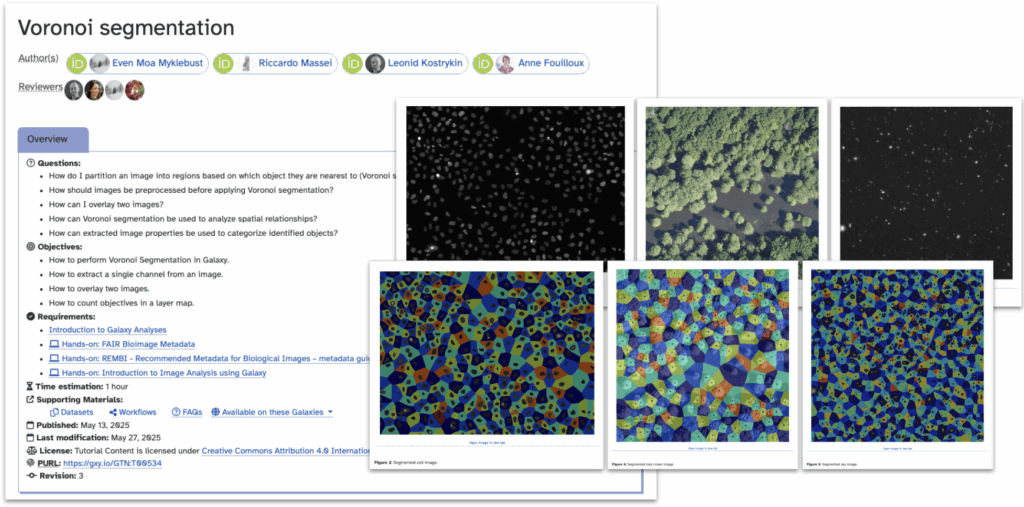
The OSCARS FIESTA project — funded by the OSCARS project — is working to break down disciplinary silos in image analysis by fostering reusable, cross-domain workflows. By connecting bioimaging, astrophysics, and environmental sciences, the project aims to build a truly FAIR ecosystem for scientific image data.
The tutorial is part of the Galaxy Training Network (GTN), ensuring it’s fully open and ready to be reused or adapted by trainers and researchers alike.
This tutorial is just the beginning. Stay tuned for more news from OSCARS FIESTA — and in the meantime, try out the tutorial and share your feedback!
Access the tutorial: https://training.galaxyproject.org/training-material/topics/imaging/tutorials/voronoi-segmentation/tutorial.html
October 15, 2026
The European RI-SCALE project has launched an Open Call for Use Cases, inviting research teams, research infrastructures and companies to…

October 15, 2026
The 2026 edition of SPAOM, the meeting of the Spanish and Portuguese Advanced Optical Microscopy community, marked a special milestone: the 10th edition of this meeting bringing together researchers, microscopy specialists, technology developers and imaging facilities.

October 13, 2026
From 27 September to 1 October, our team member Feriel Ramdhane (Image Data Scientist at Med-Hub) represented Euro-BioImaging at MICCAI 2026 in Strasbourg.