

March 30, 2026
Euro-BioImaging at the EOSC ESFRI meeting in Milan
Euro-BioImaging was delighted to attend the ESFRI/EOSC Policy Workshop on “EOSC and Research Infrastructures: Opportunities and Strategies” in Milan from March 15-16, represented by…


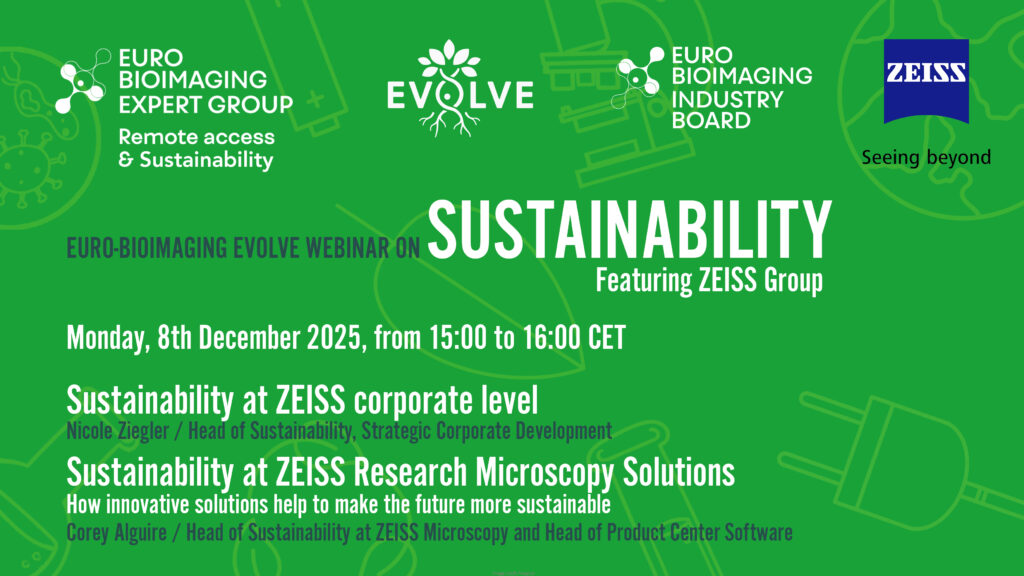
As part of the Horizon Europe EVOLVE project (GA# 101130986) and the Euro-BioImaging Expert Group on Remote Access & Sustainability, Euro-BioImaging hosted a webinar on how innovative approaches in industry can support more sustainable imaging across its facility community. The session featured presentations from Nicole Ziegler, Head of Sustainability, Strategic Corporate Development at ZEISS, and Emily Mussard-Forster, Sustainability Manager at Carl Zeiss Microscopy GmbH. ZEISS is a long-standing member of the Euro-BioImaging Industry Board, contributing strategic insight at the intersection of imaging technology, operations, and sustainability. Sixteen participants from Euro-BioImaging Nodes and the wider community joined the webinar.
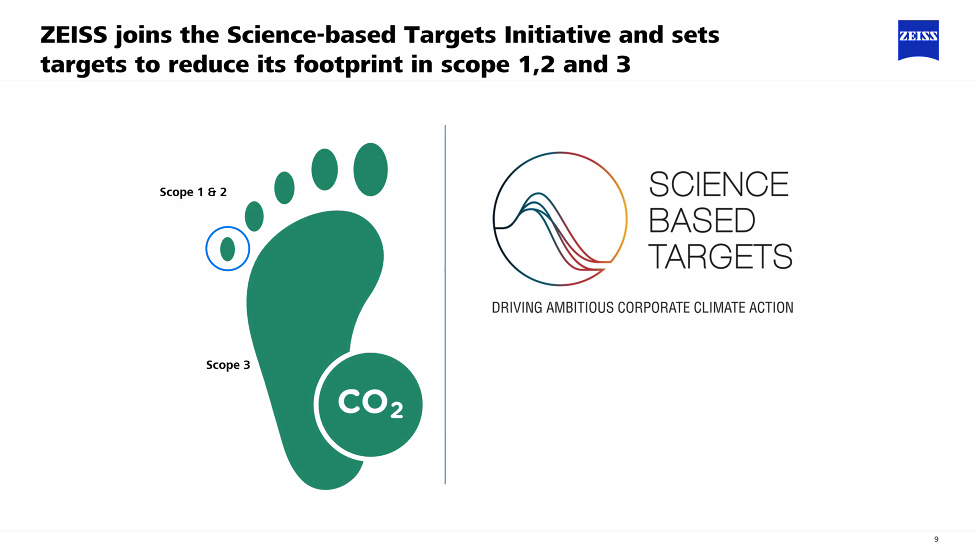
The webinar introduced ZEISS’ organisation-wide sustainability strategy, structured around climate action, circular economy principles, and creating societal value. ZEISS has achieved success in developing sustainability and reducing carbon footprints in thFor microscopy, this means examining not just the upstream production chain but also the operational footprint of the imaging systems and identifying where energy savings can be achieved. The team welcomed input from imaging facilities to refine downstream assessments, recognising that real-world usage patterns are essential for accurate sustainability evaluations.
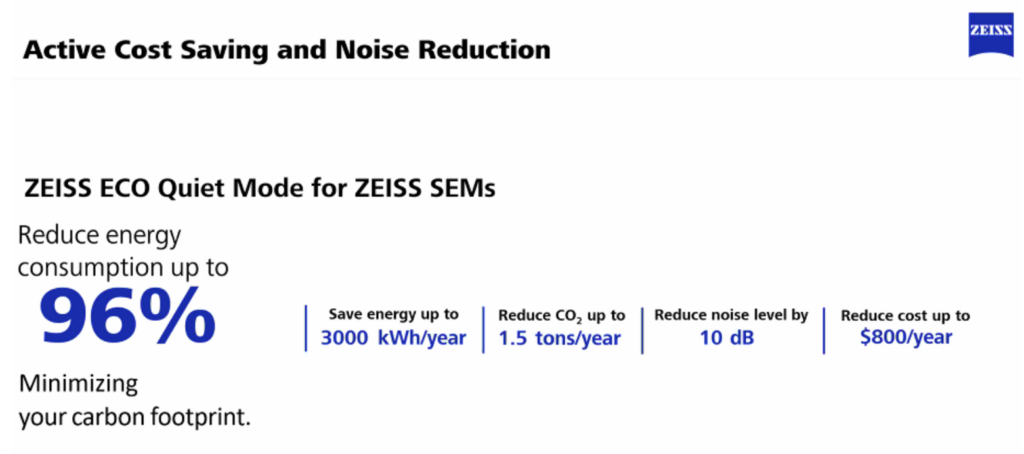
Within the microscopy division, higher-level sustainability goals translate into four core areas: product sustainability, reduced packaging, expanded remote toolsets, and energy-efficient operations across production and sales sites. Sustainability has become a formal specification in product development, supported by life-cycle assessments and training for developers on greener design principles. Customer expectations for sustainable products are also increasingly incorporated from the earliest design stages.
Concrete examples included approaches to extend hardware life through more efficient software and hardware design—such as reducing computational load, minimising unnecessary data transfer, and ensuring that power-saving features are intuitive and align with real-world user workflows. A specific option highlighted for facilities is the SEM ECO Quiet Mode, which can be installed as an upgrade to help reduce operational energy consumption and noise, and which will be integrated as standard in future systems.
Remote approaches, such as VR-based training for service technicians, remote demos, and predictive maintenance tools, help reduce travel while improving system uptime and reducing replacement rates. ZEISS also focuses on sustainability in logistics, including reusable transport containers, lower-emission shipping options such as sea freight, and pathways for product recycling at end-of-life.
Across all of these activities, the speakers emphasised that improving sustainability in microscopy requires navigating complex trade-offs between performance, energy use, material consumption, and user needs. Careful life-cycle assessment and close collaboration between manufacturers, facilities, and users are essential to guide informed decision-making.e company’s own operations through activities such as water reuse and green energy and is now building on this as part of the Science Based Targets Initiative, addressing emissions across its entire value chain, including Scope 3.
March 30, 2026
Euro-BioImaging was delighted to attend the ESFRI/EOSC Policy Workshop on “EOSC and Research Infrastructures: Opportunities and Strategies” in Milan from March 15-16, represented by…
March 30, 2026
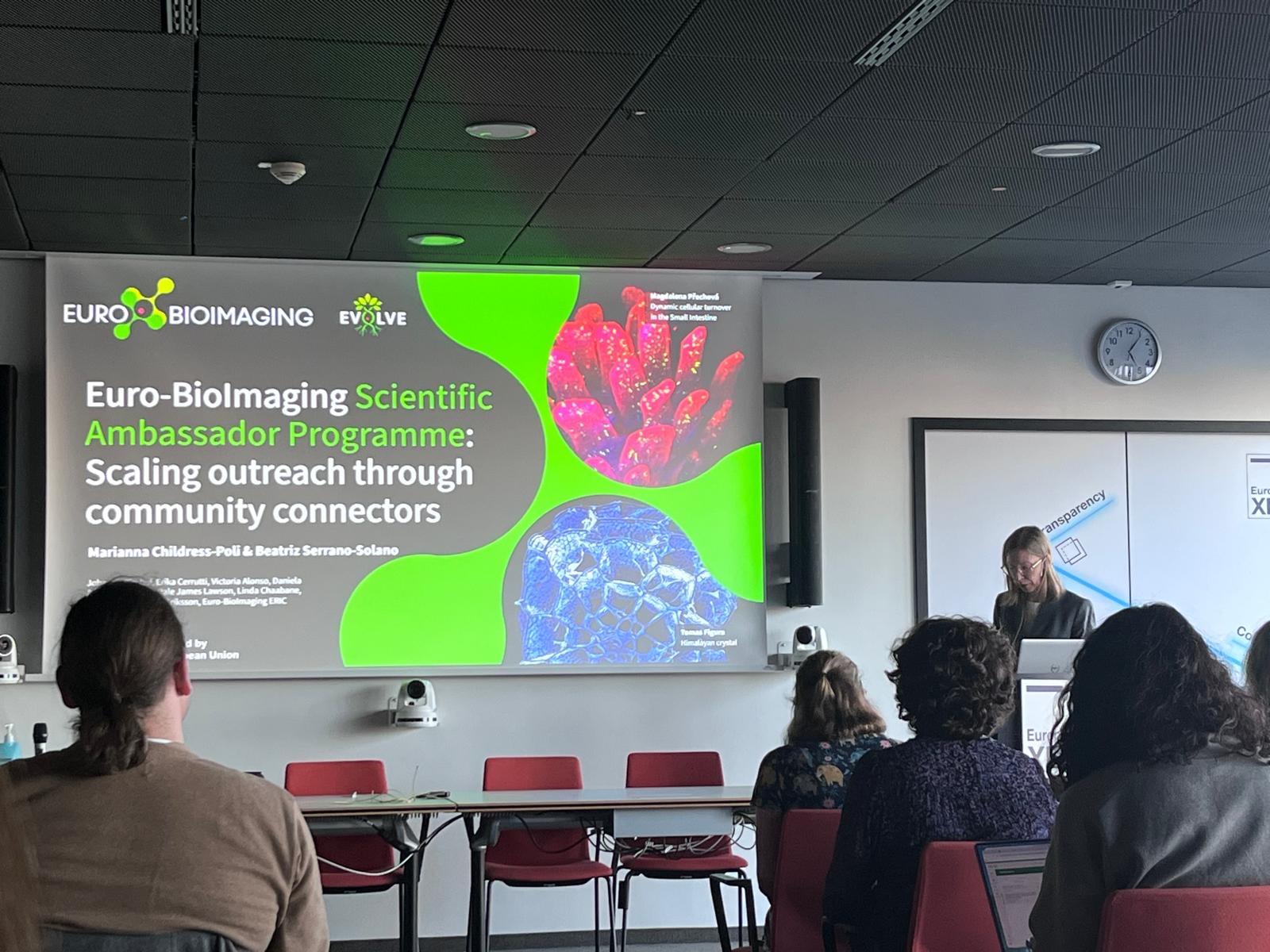
Euro-BioImaging was delighted to attend the Public Awareness & Engagement of Research Infrastructures (PAERI) conference, represented by External Communications Officer, Marianna Childress-Poli. This year’s…
March 26, 2026
The Madrid Advanced Microscopy Center (MAdMiC) is the first Euro-BioImaging Node in Madrid (Spain). It is formed through the collaboration and close work of…