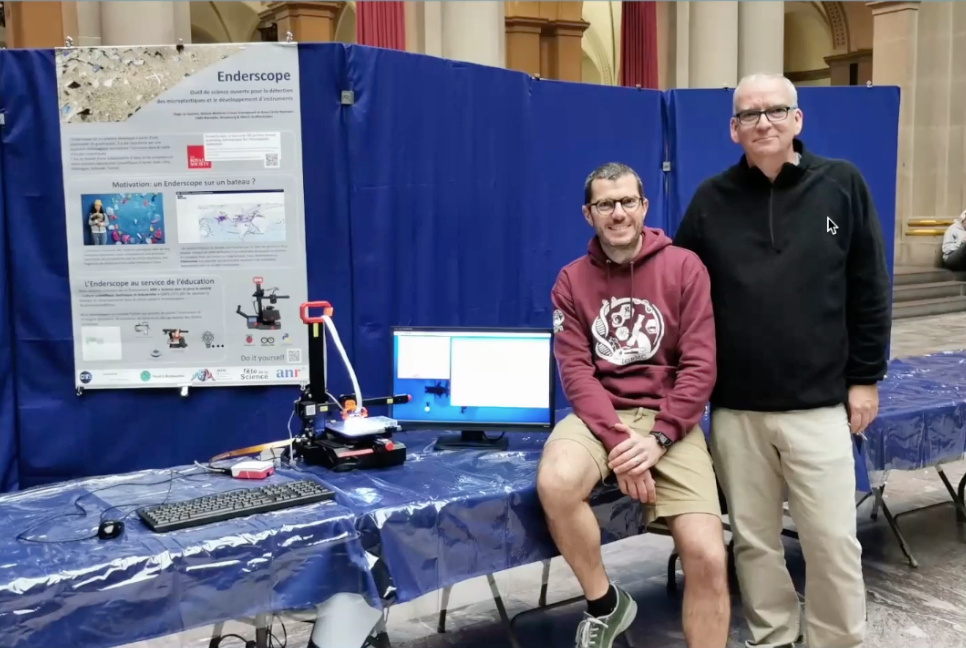
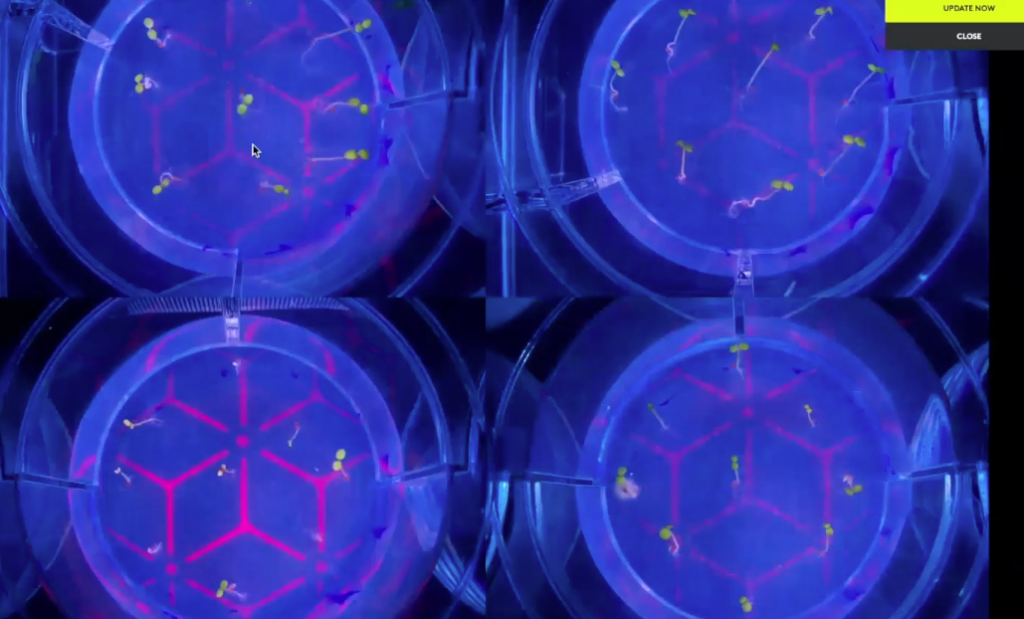
What costs less than 300 Euros, weighs 1.8 kgs, fits into a 30 cm x 30 cm box, and can do a mosaic scan of a large area in brightfield and fluorescence? It’s the EnderScope, a low-cost, open source, light and fluorescence microscopy system, originally designed to perform on-site measurements of microplastics and shed light on global marine microplastic pollution. Developed by Niamh Burke, University College Dublin, with contributions from an international team including Jerome Mutterer, from France BioImaging’s Strasbourg Node, this compact, innovative system can be adapted to serve multiple applications – and proves to be a fantastic teaching tool. We spoke to Jerome Mutterer and Erwan Grandgirard, to learn how they are working to develop – and promote - a range of relevant applications with this low-cost portable microscopy system.
Jerome Mutterer (Institute for Plant Molecular Biology) and Erwan Grandgirard (IGBMC: Institute of Genetics and Molecular and Cellular Biology) are both imaging core facility managers. While most of their work is dedicated to helping users, part of their job description is to develop new systems. That’s how Jerome got involved with the EnderScope. “In an age where imaging tools are increasingly specialised and expensive, many technologies have gone beyond the reach of those who can benefit from them,” explains Jerome. “I wanted to develop a low-cost microscope based on a 3D printer using open-source hardware that anyone could build and use.”
Joining forces to make it happen
An idea that a team in Dublin, led by Niamh Burke from the Mark Pickering lab, was also working on. Niamh had done the optical design, the measurements, and quality control on her prototype, while Jerome had worked on a Python-based software control system and user interface. Their work was complementary, so they decided to join forces. The original EnderScope, a cheap and reproducible device based on open-source hardware for microplastic detection, was born in 2023.
From the beginning, Jerome saw the potential of this system to go beyond its initial function. “Labs like the idea that for very cheap they can develop a microscope for their applications. What makes the EnderScope special is its reproducibility and adaptability to other applications – even those applications we haven’t imagined yet,” explains Jerome. “We need to bring this system to users who can benefit the most from a low-cost system with cutting-edge functions.” So, he together with Erwan and Hugo Le Guenno from the French RTMFM smart microscopy working group set out to raise the visibility of the EnderScope within France.
Raising visibility – from the scientific community to science teachers
In 2023, they organized a first workshop at MifoBio with David Rousseau, an expert in AI from the University of Anger. The workshop gathered 20+ project ideas for the EnderScope – and led to the creation of a Python library to drive the system at low level. Thanks to these developments, people can design their own application, applying it to any other automated microscopy workflows, effectively extending the range of applications for the EnderScope. Read the paper
Outside of Europe, Jerome and Erwan took the EnderScope to Burundi with the GDR Imabio French Microscopy interest group. And of course, they took the system to general public science festivals and teaching fairs as well.
“This device is great for teaching,” says Erwan, which is why they recently demonstrated the device at a Congress for Physics & Science teachers in Strasbourg. “It can be used to teach many things. You can teach the basics of Python language to program the device with a good user command. When you implement the code, you can see an immediate action by a real-world object, that’s very satisfying for students.”
Supporting the Smart Microscopy revolution
“What we’re really excited about is the potential of this system to teach smart microscopy,” explains Jerome. Smart microscopy – or adaptive feedback microscopy – is when a microscope is programmed to change its acquisition parameters during an experiment without human intervention. Both Erwan and Jerome are members of Euro-BioImaging’s Smart Microscopy Working Group bringing Euro-BioImaging Node staff, invited experts, and Euro-BioImaging Industry Board members together to discuss and work on standards, functionalities and workflows for ‘Smart’ Microscopy. The group aims to support the wider adoption of Smart Microscopy workflows by developing tools and training resources for facilities and end users.
Many scientists from academia and industry are working on this concept, and it is changing traditional image acquisition methods and experimental pipelines. While commercial systems exist, coding can still be required to tweak for specific scientific applications. And not all core facility staff have been exposed to building their own workflows - or know how to code in Python.
Teaching smart microscopy usually relies on very expensive systems and most labs only have one device that is smart microscopy capable. “But if you can bring devices that behave like high-end systems,” explains Jerome, “Then you can train your staff for very cheap.” Enter the Enderscope…
Build your own Enderscope – a workshop format
Jerome and Erwan have developed a workshop format to help imaging core facility staff – or science teachers - to build their own EnderScope. For about 300 Euros, they purchase all the parts - including the 3D printer, the computer to drive it (Raspberry Pi) and the camera. All additional parts can be 3D-printed. In merely two days under their guidance, participants can assemble an EnderScope, experience coding, and take the device home with them. Resources can be found at the enderscopy GitHub repository (https://github.com/mutterer/enderscopy), and related contributions are gathered by Alienor Lahlou at https://diy.microscopie.org/explore.html
To this end, they have developed Jupyter notebooks to operate a multiwell EnderScope. The code tells the camera to move, turns the shutter on and off, changes the stage – and the image acquisition – a great way for students to learn all the steps needed in programming. Since a full Enderscope Python library exists, there is starter code available for a number of applications and variations on the scope.
Unleashing the power of Smart Microscopy
“This system really has the potential to democratise imaging science, by bringing expensive applications to under-resourced environments - laboratories, universities, high schools – in Europe but also in developing countries,” says Jerome.
So he and Erwan will continue to promote the EnderScope. First, as a portable, low-cost Imaging system, capable of answering scientific questions for many applications. But above all, as a tool to teach coding skills and unleash the power of smart microscopy.
More news from Euro-BioImaging
April 9, 2026
Major EU funding for user access & AI development, staff training, data stewardship & many more exciting new services!
Euro-BioImaging ERIC is deeply grateful to announce that the European Union has entrusted our infrastructure with funding to shape the future of imaging and…
Euro-BioImaging is looking for an Operations Support Assistant at the Euro-BioImaging Statutory Seat in Turku, Finland, to support the day-to-day financial and administrative operations…