EOSC
Contributing to open science and open data is a key priority for Euro-BioImaging. With the vision for making data and services in the European Research Area more interoperable, across geographical and domain boundaries, and representing requirements and interests of the imaging community, Euro-BioImaging is actively participating in creating a functional European Open Science Cloud (EOSC) that will serve our users and beyond.
What is EOSC?

The European Open Science Cloud is a technological and policy endeavour that aims to create a “Web of FAIR Data and Services” for science in Europe. It will enable a trusted virtual environment, based on common core functionalities, to support Open Science. Key digital infrastructure, data, and services will be accessible to researchers, to help them store, share, process, analyse and reuse FAIR research outputs within and across disciplines.
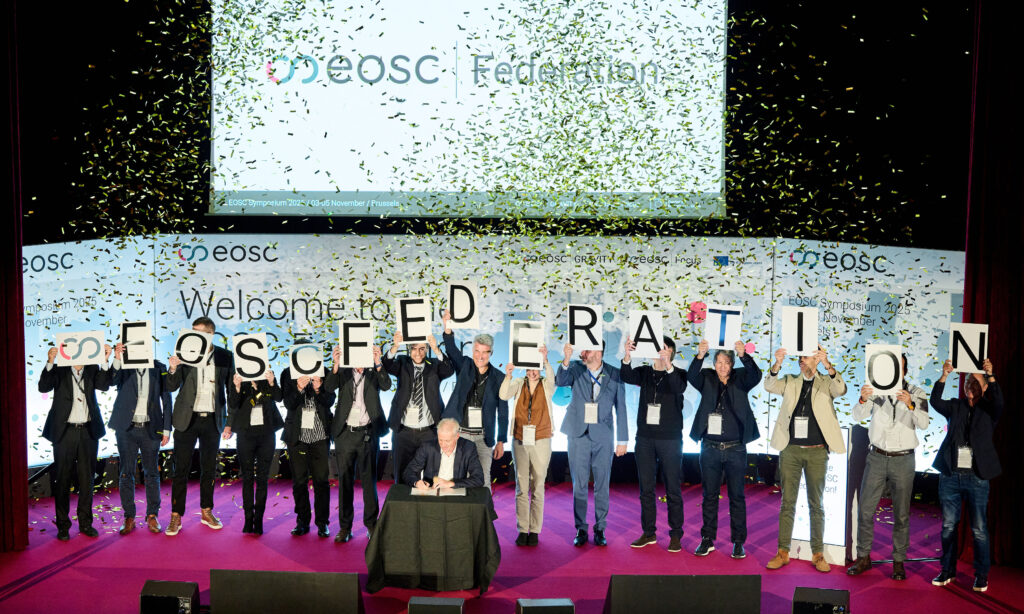
From the perspective of a researcher or service provider, the EOSC is currently being deployed in the form of the EOSC Federation consisting of multiple national and thematic EOSC Nodes that are interconnected and can collaborate to share and manage scientific data, knowledge, and resources within and across thematic and geographical research communities.
One such Node is the EOSC EU node, which is providing European researcher the following services:
- File Sync and Share : Personal cloud storage for collaborative research.
- Interactive Notebooks: A shared space for coding and analysis.
- Large File Transfer: Fast and secure file transfers.
- Virtual Machines: Scalable cloud computing for reliable and reproducible results.
- Cloud Container Platform: Simplified Kubernetes for scalable research.
- Bulk Data Transfer: Smooth high-volume data transfers.

Euro-BioImaging is involved with the Life Sciences Connect Node (LSC Node) alongside its life sciences research infrastructure partners ELIXIR, EMBL, and Instruct ERIC. The LSC Node will serve as a thematic entry point for life science users in the EOSC and provide them various relevant and interoperable services, as well as connection to generic services and infrastructure through the wider EOSC federation.
Euro-BioImaging in the EOSC
Since 2021, Euro-BioImaging has been a member of the EOSC-Association (EOSC-A), which is a legal entity coordinating co-creation of the EOSC. Over the years, through our participation in EOSC-A Task Forces around topics like Researcher engagement and adoption, Technical and semantic interoperability, FAIR Metrics and digital objects, and Health Data, and in working groups together with organisations in the ERIC Forum and ESFRIs, we have been providing inputs to the Strategic Research & Innovation Agenda and its Multi-Annual Roadmap that shape future research and innovation activities. These activities cover inputs on policy as well as technical alignment to support open science through the EOSC. In 2022-23 Euro-BioImaging established the representation of, and then acted as the Mandated Organization in the EOSC-A, on behalf of the ERIC Forum, representing the voices of all ERICs who are members in the EOSC-A.
As of January 2026, Antje Keppler, Director of our Bio-Hub, has been elected to the EOSC Association Board of Directors, allowing Euro-BioImaging to strengthen our support of the EOSC and contributing to setting open science policy priorities at a very crucial time for EOSC. This also promotes a strong representation of the Life Sciences Research Infrastructures and ERICs in co-creating the EOSC. On the operational side, to ensure that the EOSC Federation can align on minimum requirements, and build common processes to adopt interoperable services across the various national and thematic Nodes, Aastha Mathur, our Head of Image Data Services, is co-chairing the EOSC Federation’s interim Node Operations Committee. Representing Euro-BioImaging and the EOSC LSC Node in the operational build up of the EOSC. This will ensure that our data and service requirements, together with those of the life sciences community are catered for to facilitate integration into the EOSC.