Rhone-Alpes
The Rhone-Alpes sub-Node is composed of two centers: LyMIC in Lyon and ISdV in Grenoble. Gathered into one entity, LyMIC consists of three core facilities providing advanced photonic, atomic force and advanced electron microscopies. ISDV comprises six facilities covering photonic microscopy and electron microscopy expertise.
Six R&D teams complete and support the facilities, located at Ecole Normale Supérieure de Lyon (ENS, Lyon); Grenoble Institute for Neuroscience (GIN, Grenoble); Institute for Advanced Biosciences (IAB, Grenoble); Institut Lumière Matière (ILM, Lyon); Laboratoire interdisciplinaire de Physique (LiPhy, Grenoble).
The Rhone-Alpes sub-Node has key expertise in approaches to study biomechanical and bio-elastic properties, adaptive optics development, sophisticated large data analysis from 3D mapping gene transcript to thick FIB-SEM data, and dynamic imaging of metabolites.
Normandy
The Normandie Node is composed of one imaging facility,called PRIMACEN (HeRacLeS, US 51-UAR 2026, with user service, research and development activities), and six highly visible R&D teams (SFR IRIB, NORVEGE, INC3M, SCALE and BB@C) who are experts in microscopy techniques, controls and tools. Mainly located in Rouen and distributed to Caen and Le Havre, the Normandie node is offering high level technical and innovative methodological expertise in multi-scale imaging (TEM, STED, FLIM, TIRF, 2P, LSM…) at the interface between physiology, biology, chemistry, bioimage analysis, from the molecule to the small animal/plant. The Normandie Node has expertise in vascular sciences, microalgal biosciences and intercellular communication.
Moreover, the Normandy sub-Node runs the International master program in Cell Imaging (IMAC) where students are intensively trained on PRIMACEN equipment and have the opportunity to go abroad including Finland thanks to a tight cooperation across Euro-BioImaging Nodes offering Master’s programs in imaging.
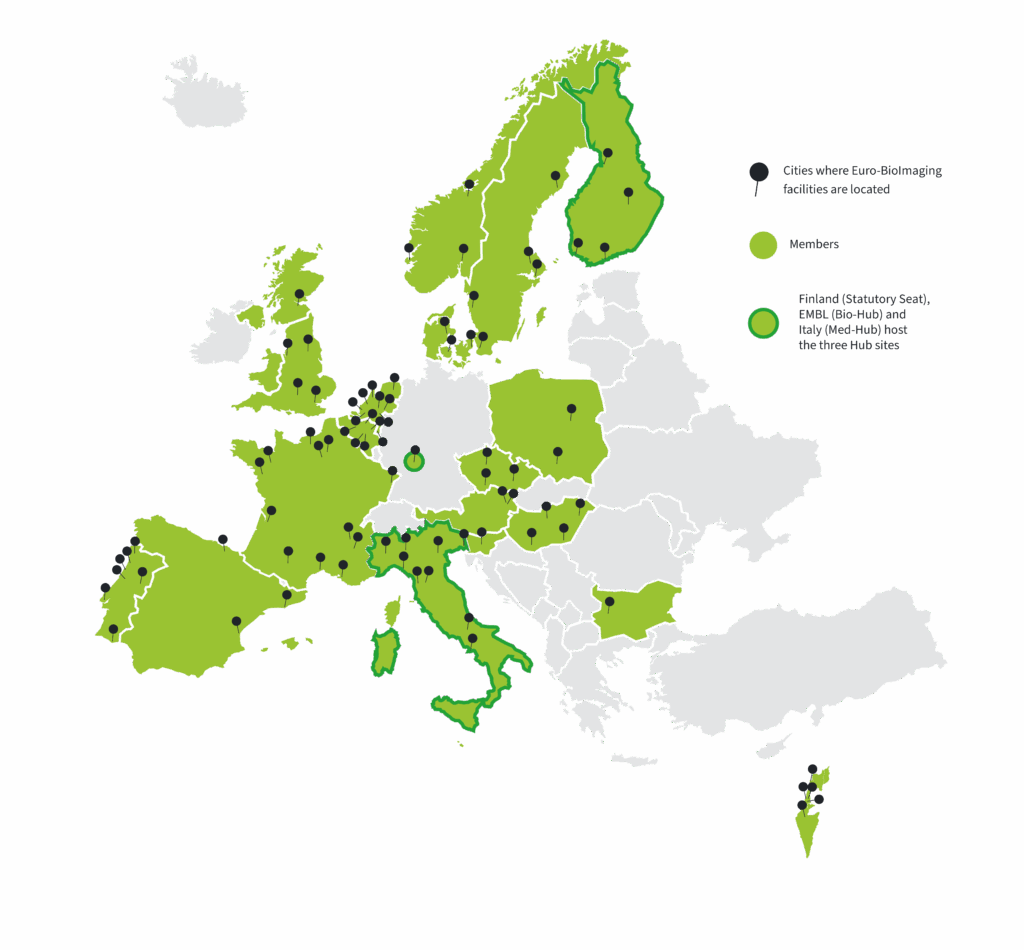
This Node Upgrade brings the Euro-BioImaging French Node into alignment with the national France BioImaging community and forms its final perimeter with the integration of these 2 new FBI nodes. The upgraded French Node now gathers 10 geographical nodes, ensuring broad geographical territory coverage and national coordination and alignment across the community.