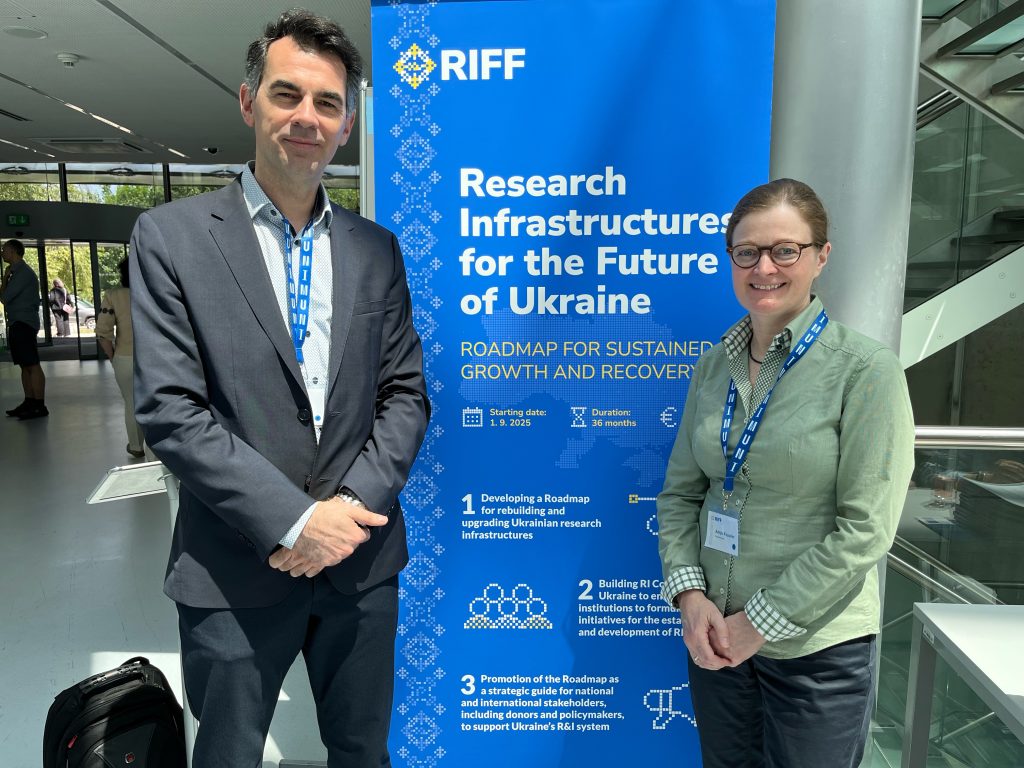
Euro-BioImaging, represented by Bio-Hub Section Director, Antje Keppler, participated in the RIFF Thematic Summit on Health & Food, Environment, and Data, Computing & Digital Research Infrastructures, held on 15–16 June 2026 in Brno, Czech Republic. The event brought together Ukrainian researchers, research infrastructure managers, policymakers and representatives of European research infrastructures to explore concrete pathways for Ukraine’s integration into the European Research Area.
The Summit was organised in the framework of the RIFF project – Research Infrastructures for the Future of Ukraine – which supports the development of a roadmap for the recovery, strengthening and future integration of Ukrainian research infrastructures.
"While commonly developing the mid- and long-term strategy for including Ukrainian research infrastructures into the European ecosystem, already today researchers from Ukraine can benefit from many publicly available resources offered by the European research infrastructures. Examples are public research data bases, virtual training courses and online resources, transnational access funding opportunities, or simply by joining virtual RI community meetings for engagement and exchange of experience.”
-- Antje Keppler, Euro-BioImaging Bio-Hub Section Director
Euro-BioImaging contributed to the Health & Food session, presenting opportunities for Ukrainian scientists to access advanced biological and biomedical imaging technologies, expert support, image data services and training across the Euro-BioImaging family of Nodes. The presentation also highlighted examples of imaging support relevant to Ukraine’s current research needs, including environmental health, cancer research, food security, plant stress, plant-pathogen interactions and agricultural reconstruction.
A concrete example of collaboration
A concrete example was the access of a Ukrainian research team from Zaporizhzhya State Medical and Pharmaceutical University to advanced imaging at the Austrian BioImaging/CMI Node through the canSERV project. The project investigates war-related environmental toxin exposure in pregnant women and newborns, demonstrating how European research infrastructures can provide access to technologies that may not be available locally under current conditions.
The session led to a lively discussion with Ukrainian colleagues, who were particularly interested in how to access Euro-BioImaging services, how to participate in EU-funded transnational access opportunities such as INFRASERV projects, and how Ukrainian scientific communities can further self-organise to prepare for future participation in European research infrastructures, including ERICs.
Antje Keppler, Section Director Bio-Hub, recommends “While commonly developing the mid- and long-term strategy for including Ukrainian research infrastructures into the European ecosystem, already today researchers from Ukraine can benefit from many publicly available resources offered by the European research infrastructures. Examples are public research data bases, virtual training courses and online resources, transnational access funding opportunities, or simply by joining virtual RI community meetings for engagement and exchange of experience.”
Euro-BioImaging looks forward to continued dialogue with Ukrainian researchers and institutions, and to supporting access, training, data services and community-building efforts that contribute to Ukraine’s scientific resilience and long-term integration into the European Research Area.
More news from Euro-BioImaging
October 16, 2026
Interactive effects of microplastics and silver nanoparticles on onion roots: uptake, localisation and ROS detection via FLIM microscopy
At the Special Edition Virtual Pub, “Imaging Micro- and Nanoplastics,” Euro-BioImaging users, Node experts and Industry partners will explore how advanced microscopy, clinical…
From microplastics to pixels: open-source image analysis tools to study pollutant effects in zebrafish
At the Special Edition Virtual Pub, “Imaging Micro- and Nanoplastics,” Euro-BioImaging users, Node experts and Industry partners will explore how advanced microscopy, clinical…
Multimodal SRS and STED Microscopy for Identification and Intracellular Localization of Nanoplastics
At the Special Edition Virtual Pub, “Imaging Micro- and Nanoplastics,” Euro-BioImaging users, Node experts and Industry partners will explore how advanced microscopy, clinical…