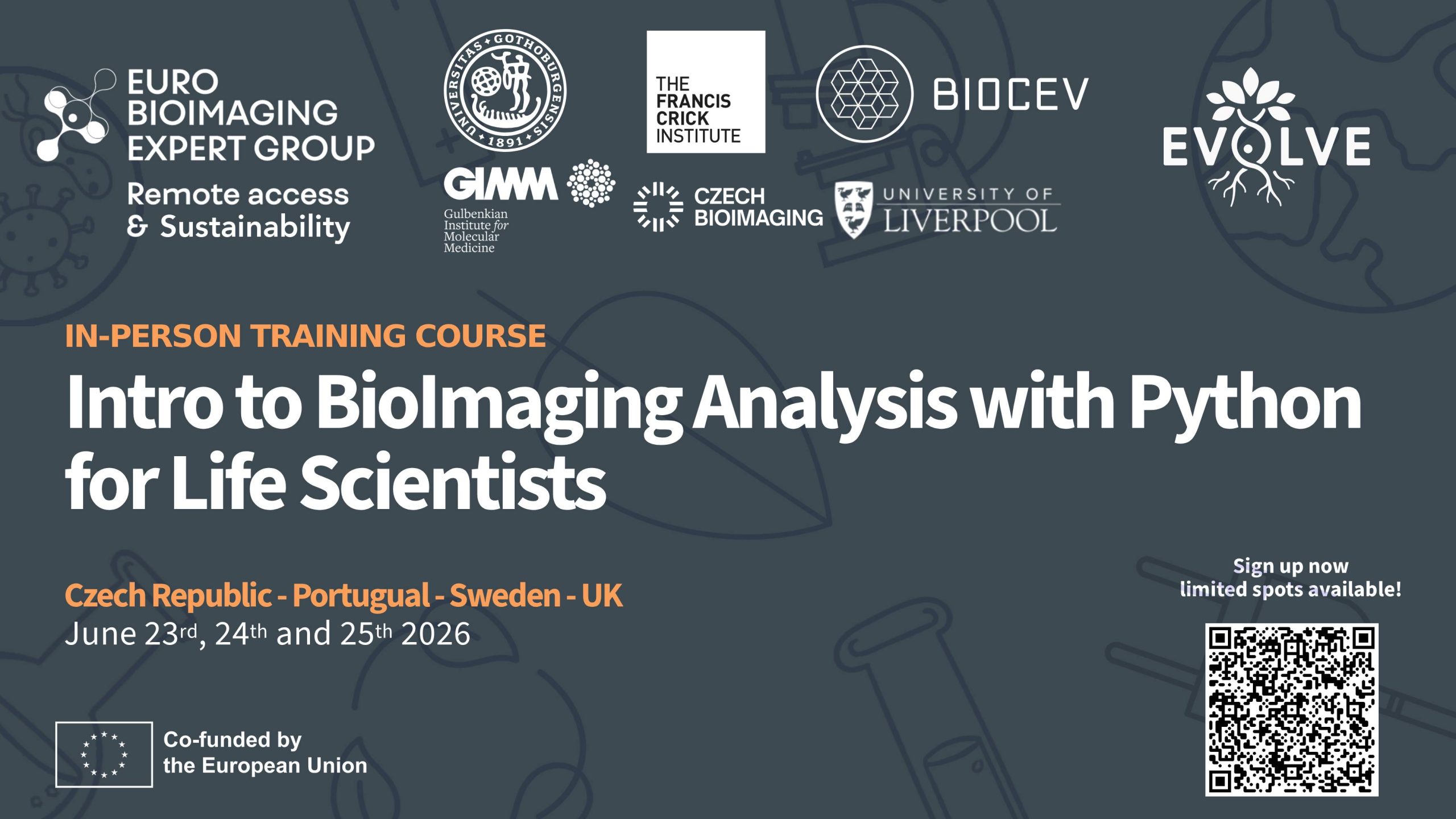
After a very successful first edition, Euro-BioImaging is proud to announce the second edition of the distributed training course for "Intro to BioImage Analysis with Python for Life Scientists" from June 23rd to 25th 2026. This course is jointly organised by four Euro-BioImaging Nodes and will be run at four connected training centres that are part of Euro-BioImaging:
University of Gothenburg, Sweden - NMI Sweden Node
Gulbenkian Institute of Molecular Medicine (GIMM), Oeiras, Portugal - PPBI Node
The Francis Crick Institute, London and University of Liverpool, Liverpool - UK Node
BIOCEV, Vestec, Czech Republic - Prague Node
Distributed in-person training
This course is organised under the EVOLVE project (Grant agreement N° 101130986) as part of Euro-BioImaging’ effort in increasing the adoption of hybrid training thus combining the advantages of remote and in-person training.
This distributed course will be held in person at the four locations and the four local training hubs will be remotely connected and jointly going through the training programme provided each day by one of the sites.
This means that students can enjoy the advantages of small in-person training - connecting with their fellow students and direct support from their trainers - as well as being connected on an international level and benefit from the training and image analysis expertise at all the training centres.
Target audience for the course
The course is designed for life science researchers with some Image Analysis experience who want to push their analysis capabilities to the next level by using Python and Jupyter Notebooks, as well as implementing and applying analysis tools developed by the community for their image analysis challenges.
Financial support to cover travel and accommodation (Max. 500 EUR per person) is available upon request and for a limited number of participants.
Practical information
More details on the training program and prerequisites can be found here .
Registration is open until April 15th , and local travel grants are available here.
This course is a follow up to the first version organised as part of the Euro-BioImaging involvement in the eRImote project, focussing on "Remote and Virtual Access to Research Infrastructure Services", and a significant component of the training will build on the outcomes from the AI4Life project. This part of the training will familiarise students with the BioImage Model Zoo and ZeroCostDL4Mic.
The course will implement BAND as a backup joint virtual platform for students unable to meet course working environment requirements. BAND was developed as part of the Euro-BioImaging involvement in the EOSC-Life project by Jean-Karim Heriche and Yi Sun from EMBL [link].
This training event also benefits from the EGI Training Infrastructure service supported by national resource providers in the EGI Federation. In particular, CESNET is providing the computational resources and support to host BAND for this training event.
This activity, therefore, brings together outputs and initiatives from different EU projects and collaborations in the European data space to benefit life science researchers and make new ways of training possible.
More news from Euro-BioImaging
April 7, 2026
canSERV User Meeting highlights impact and future perspectives for cancer research in Europe
The canSERV Annual Meeting, held in Brussels from 25–27 March 2026, brought together researchers, service providers, Research Infrastructures, policymakers, and patient representatives to reflect…
We were delighted to take part in the 21st European Molecular Imaging Meeting (EMIM), held in Ljubljana, Slovenia, from March 24–27, 2026. The conference…
Euro-BioImaging Welcomes its 2026 Scientific Ambassadors Cohort
Following the continued success of the Scientific Ambassadors programme, Euro-BioImaging is delighted to welcome its 2026 cohort. Building on the strong foundation laid by…