
October 13, 2026
Euro-BioImaging at MICCAI 2026 in Strasbourg, France
From 27 September to 1 October, our team member Feriel Ramdhane (Image Data Scientist at Med-Hub) represented Euro-BioImaging at MICCAI 2026 in Strasbourg.



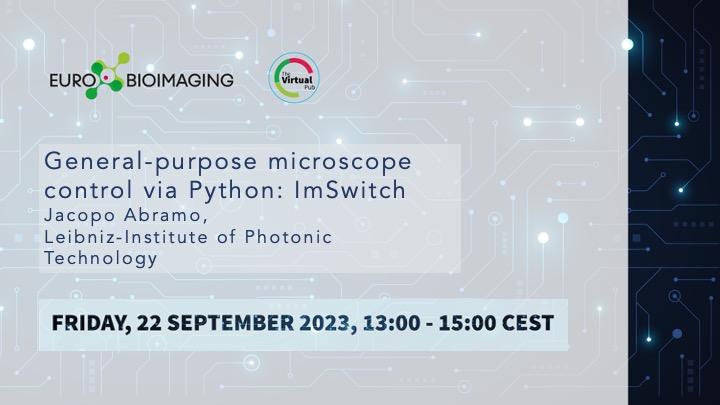
Imaging technologies are becoming increasingly complex and ever more expensive, reducing the general accessibility and potential reach of cutting-edge techniques. The Special Edition Virtual Pub “Open Hardware in Imaging,” in collaboration with the Euro-BioImaging Industry Board, will highlight developments from scientists and companies who are committed to making biological & biomedical imaging hardware and software solutions openly available to a wide audience.
When: September 22, 2023, from 13:00-15:00 CEST
Where: Online
At this event, Jacopo Abramo, Leibniz-Institute of Photonic Technology, will present General-purpose microscope control via Python: ImSwitch - (full abstract below). Hear this talk and others like it on September 22!
ABSTRACT
General-purpose microscope control via Python: ImSwitch
Jacopo Abramo
Leibniz-Institute of Photonic Technology, Jena, Germany
ImSwitch is an open-source microscope control software designed for custom-built microscopy setups. Fully developed in Python, it uses a Model-Viewer-Presenter (MVP) architecture - a standard in the industry as well. It offers strong modularity through customizable widgets that can be loaded as needed through JSON configuration files. ImSwitch supports hardware synchronization for scanning techniques and provides an extendable hardware layer, enabling seamless integration of different microscope components. By embedding napari, it also opens the possibility of using existing napari plugins in cohesion with the software. The ImSwitch community also aims to enrich the device control layer by integrating the Micro-Manager core with its rich support of devices.
October 13, 2026
From 27 September to 1 October, our team member Feriel Ramdhane (Image Data Scientist at Med-Hub) represented Euro-BioImaging at MICCAI 2026 in Strasbourg.

October 13, 2026
Blood flow within tumours is often irregular and disorganised, influencing how they grow and respond to treatment. At the University of Liverpool’s…

October 12, 2026
The second edition of the EVOLVE Mentoring Programme has come to a close, marking the end of several months of mentoring, knowledge exchange…