
October 13, 2026
Euro-BioImaging at MICCAI 2026 in Strasbourg, France
From 27 September to 1 October, our team member Feriel Ramdhane (Image Data Scientist at Med-Hub) represented Euro-BioImaging at MICCAI 2026 in Strasbourg.



Blood flow within tumours is often irregular and disorganised, influencing how they grow and respond to treatment. At the University of Liverpool’s Centre for Preclinical Imaging (CPI), a collaboration supported by Global BioImaging’s Imaging 4 All initiative, funded by the Wellcome Trust, is exploring whether a more affordable imaging technique could help researchers study these patterns. Visiting researcher Dr Sourav Bhaduri, an Assistant Professor at the Institute for Advancing Intelligence at TGC Crest in India, is working with Professor Harish Poptani, Chair of CPI, and his team to develop and validate a protocol for studying blood flow in mouse models of glioma. Their project brings together advanced imaging infrastructure and computational expertise, showing how international exchanges can open new avenues for research.
CPI offers researchers and industrial partners access to a wide range of non-invasive imaging technologies through Euro-BioImaging’s UK Node. For this project, the team is combining magnetic resonance imaging (MRI) with multispectral optoacoustic tomography (MSOT), a technique that uses light and ultrasound to produce images of tissues.
MRI provides established methods for assessing tumour perfusion—the passage of blood through tissue—but its cost and infrastructure requirements can limit access. MSOT offers a potentially more affordable option for preclinical research. The team wants to understand how closely measurements from dynamic MSOT reflect those obtained with dynamic contrast-enhanced MRI (DCE-MRI).
“This grant has provided me with much more than access to imaging infrastructure. It has given me access to expertise, hands-on training and an environment for long-term collaboration.”
-- Dr. Sourav Bhaduri, TGC Crest
“Since MSOT is a relatively cost-effective imaging modality, this could be a real game-changer for researchers working in resource-constrained preclinical settings,” says Dr Bhaduri.
By tracking changes in image intensity over time after injection of a contrast agent, the researchers aim to map areas of higher and lower blood supply within tumours. Such information could help researchers understand why different regions of a tumour respond differently to treatment.
To make the comparison as reliable as possible, both methods will be used in the same animals during coordinated imaging sessions, under the same anaesthesia conditions. Working together on site allows the team to check image quality in real time and maintain consistency across measurements and time points.
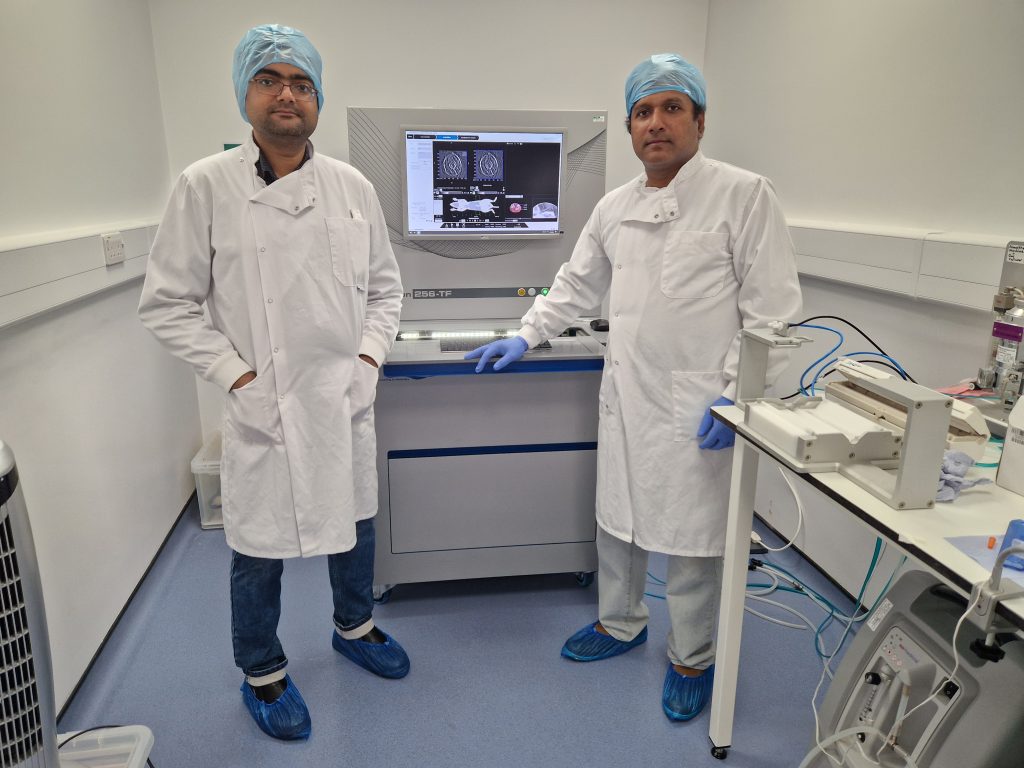
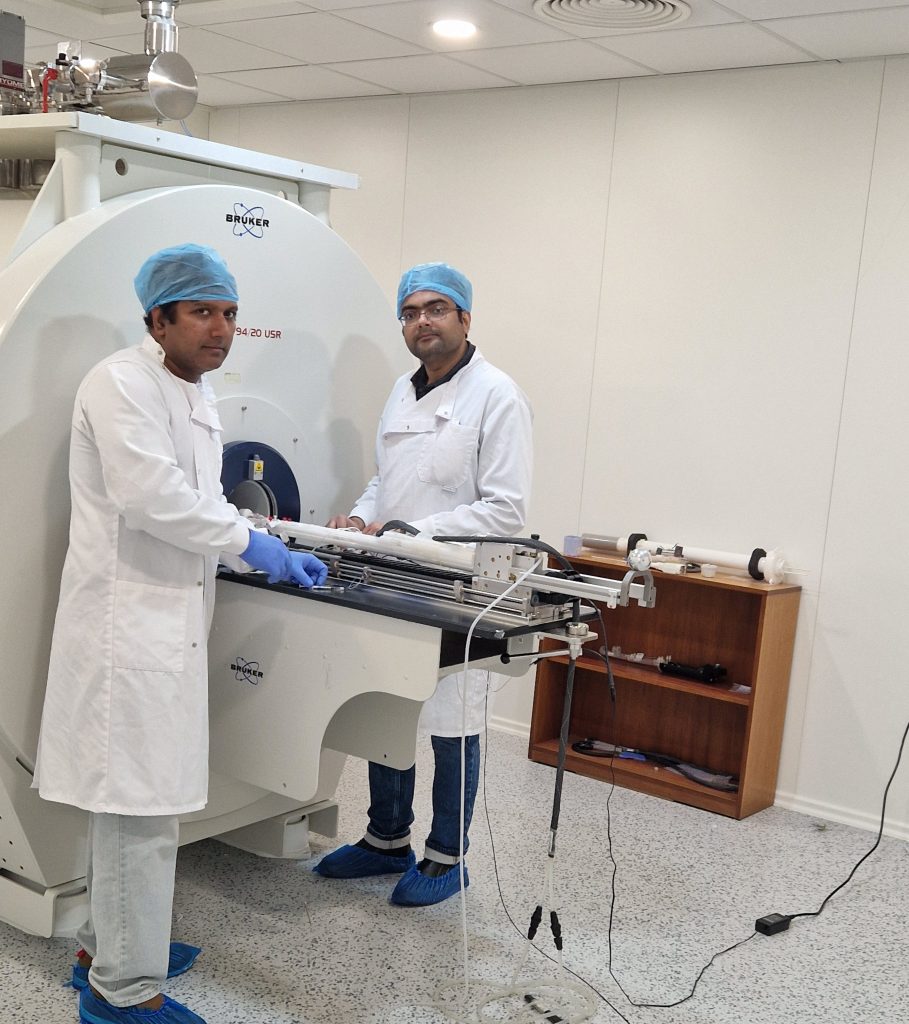
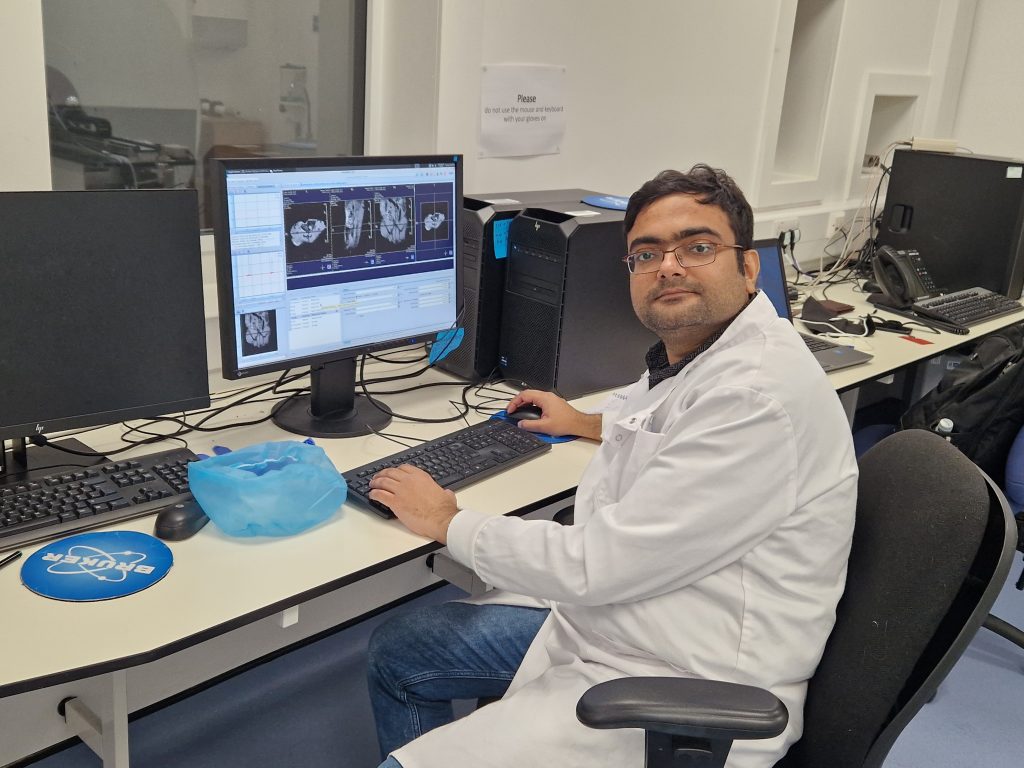
The collaboration brings together complementary skills. Dr Bhaduri, a medical image analysis specialist from West Bengal,India and has extensive experience in dynamic MRI and magnetic resonance spectroscopy, but had not previously worked with dynamic MSOT. The CPI team contributes expertise in image acquisition and experimental protocols, while Dr Bhaduri brings the computational skills needed to compare the measurements.
“Having Sourav’s computational expertise is very useful to the facility,” says Professor Poptani. “Together, we will build the imaging workflow and mathematical models that make it possible to compare dynamic MSOT with DCE-MRI.”
The project combines imaging experiments in Liverpool with computational analysis in India. In the longer term, the researchers hope this shared approach will support further collaboration, the development of imaging biomarkers and wider access to research tools.
For Dr Bhaduri, the Imaging 4 All grant has offered much more than access to equipment. Taking part in the experiments has given him new insights into how practical decisions in image acquisition can shape the data.
“Having Sourav’s computational expertise is very useful to the facility. Together, we will build the imaging workflow and mathematical models that make it possible to compare dynamic MSOT with DCE-MRI,”
-- Dr. Harish Poptani, Centre for Preclinical Imaging, University of Liverpool
“I have learned about animal preparation, positioning, timing for dynamic acquisitions, administration of contrast agents, and how to maintain consistency between measurements,” he explains. “The scientific guidance from Professor Poptani and the practical experience and support of Dr Mohesh Moothanchery have been extremely valuable. The opportunity to participate in the experiments and address questions as they arise, in real time and alongside experts, is what convinced me to apply to Imaging 4 All.”
“This grant has provided me with much more than access to imaging infrastructure. It has given me access to expertise, hands-on training and an environment for long-term collaboration,” he says. “I’m very thankful to Harish and his team for hosting me.”
The researchers hope their collaboration will lead to a publication and tools that other researchers can use. Once the protocol has been validated and shown to produce reliable quantitative data, they will make the methods openly available. Professor Poptani also hopes to offer the approach as a service at CPI.
“This is a really nice example of what Imaging 4 All can do,” he says. “Working with Sourav through the programme is a win-win situation. The knowledge exchange is extremely rich. I’m very thankful to Euro-BioImaging for involving us in initiatives like this.”
International collaboration is central to CPI’s work. In 2026, the facility welcomed researchers and imaging facility staff from Turkey, Israel, Norway and India through Euro-BioImaging and Global BioImaging initiatives. CPI staff also visited the CAPI Node in Prague through Euro-BioImaging’s EVOLVE job shadowing programme.
For Professor Poptani, these exchanges are very valuable to both parties, and he is happy that an ever widening circle of researchers is aware of the equipment and expertise available in Liverpool.
“Word of mouth is our best ambassador,” he says. “We are happy to have more people talking about what we can do and what we are willing to do. We are thankful to those who choose to carry out their research with us.”
“Knowledge has no boundaries,” he concludes.
October 13, 2026
From 27 September to 1 October, our team member Feriel Ramdhane (Image Data Scientist at Med-Hub) represented Euro-BioImaging at MICCAI 2026 in Strasbourg.

October 12, 2026
The second edition of the EVOLVE Mentoring Programme has come to a close, marking the end of several months of mentoring, knowledge exchange…
October 8, 2026
This September, Euro-BioImaging was part of the Data Stewardship goes Germany (DSgG) Community Meeting in Cologne. Under the theme “from going to…