As part of the “Imaging 4 All - Access Track” programme, Dr Brice Tonfack, from the University of Yaoundé I (Cameroon), was awarded a grant to collaborate with Jean-Luc Verdeil, Scientific Head of the MRI-PHiV imaging platform at CIRAD in Montpellier, part of Euro-BioImaging's France-BioImaging Node. Going beyond the access to multiple modalities of imaging technologies, this research stay made it possible to establish a strong and long-term scientific collaboration between Dr Tonfack’s laboratory and the MRI-PHiV. We met with Jean-Luc and Brice, who kindly agreed to answer our questions to help us better understand the objectives and benefits of this exchange.
Interview article written by Marine Béraud, France-BioImaging.
Brice, could you briefly introduce yourself?
[Brice] I am Dr Libert Brice TONFACK, Associate Professor in Plant Biotechnology and Environment at the University of Yaoundé I, where I have been teaching and conducting research since 2011. My academic path was built between Cameroon, France and South Africa, with a PhD in plant biotechnology and a postdoctoral experience at the University of Pretoria. My research focuses on the valorisation of underexploited tropical plants, sustainable agriculture under stress conditions, and functional genomics, with the aim of linking fundamental research to concrete applications in support of sustainable development in Africa.
What research project are you currently working on?
[Brice] I am currently working on a project dedicated to the valorisation of underexploited tropical species from the genus Aframomum, in collaboration with CIRAD in Montpellier. Using bioimaging and microscopy tools, we are studying seed diversity and structure. The challenge is both scientific and societal: to better understand these still poorly studied species, reveal their medicinal, food or cosmetic potential, and contribute to their conservation as well as to the development of the communities that depend on them.
Brice, how did you experience the Imaging 4 All - Access Track programme?
[Brice] My experience with this programme was extremely enriching. This stay made it possible to lay the foundations for an ambitious and sustainable scientific collaboration between my laboratory and the MRI-PHiV platform at CIRAD. The welcome, organisation and scientific support were exemplary, and the state-of-the-art infrastructures enabled the generation of very high-quality data. The programme’s financial support was decisive for the success of the project and had a strong impact on my research activities and international collaborations.
Why did you choose a France-BioImaging platform?
[Brice] I chose a France-BioImaging platform because plant imaging is still underrepresented, and the MRI-PHiV platform in Montpellier is one of the few high-level infrastructures dedicated to plant research. I was put in contact with Jean-Luc Verdeil through Jean Salamero, and an initial visit to the platform in 2024 made it possible to initiate scientific exchanges and give rise to a joint project, which was subsequently developed collaboratively at a distance.
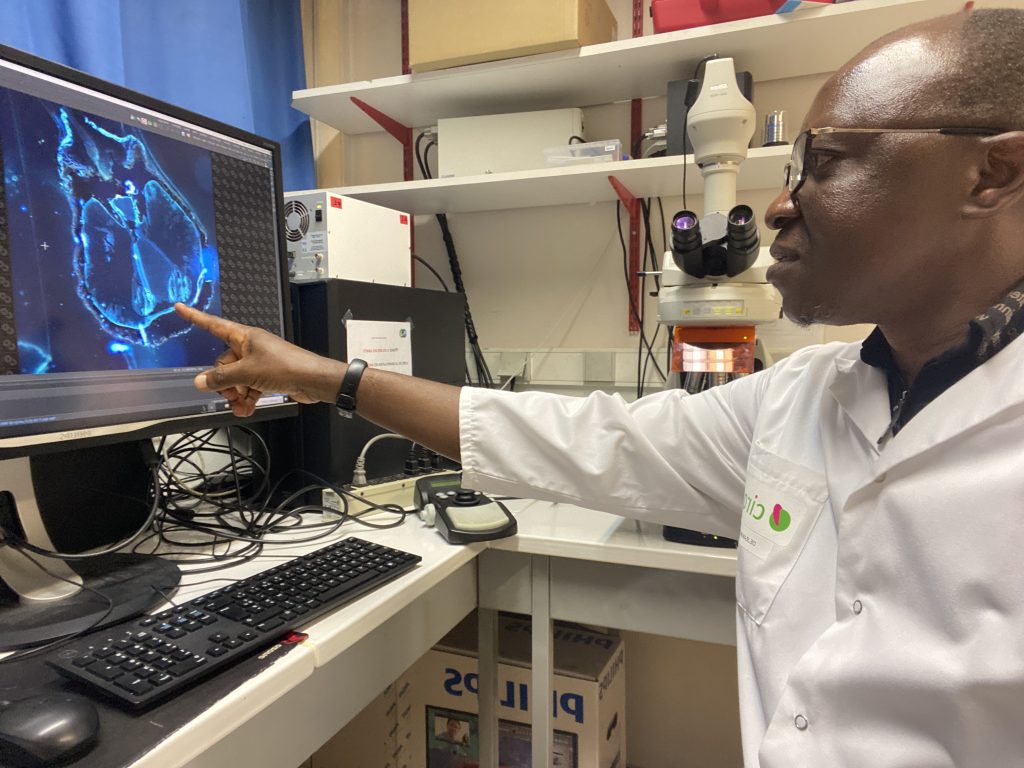
Dr Brice Tonfack looking at autofluorescence of plant seeds at the MRI-PHiV imaging platform at CIRAD in Montpellier thanks to an Imaging 4 All grant.
How did this stay advance your project?
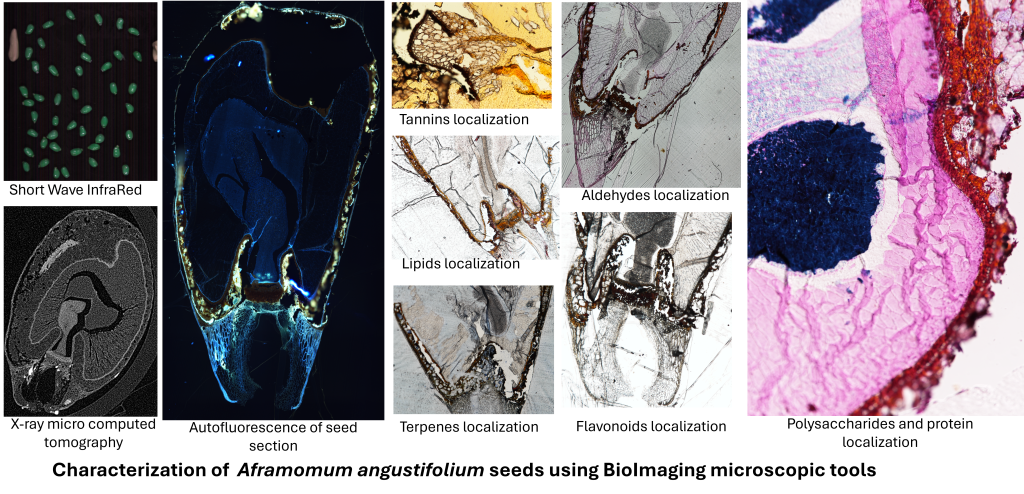
[Brice] This stay made it possible to obtain unprecedented data that I would not have been able to acquire in my own laboratory. We carried out a comprehensive characterisation of Aframomum seeds using non-invasive imaging and advanced histological and histochemical analyses. These approaches generated rich and promising datasets, representing a major methodological advance and laying the foundations for in-depth collaborative work.
Jean-Luc, how did the platform benefit from this collaboration?
[Jean-Luc] This collaboration was highly stimulating for the entire MRI-PHiV team. It allowed us to work on original and poorly studied biological material, displaying remarkable morphological and biochemical richness. The project led us to combine several imaging modalities within an integrative approach, strengthening our methodological expertise, particularly for complex samples rich in secondary metabolites. Exchanges with Brice were especially fruitful, and his perspective as a tropical biologist gave a new dimension to the images produced.
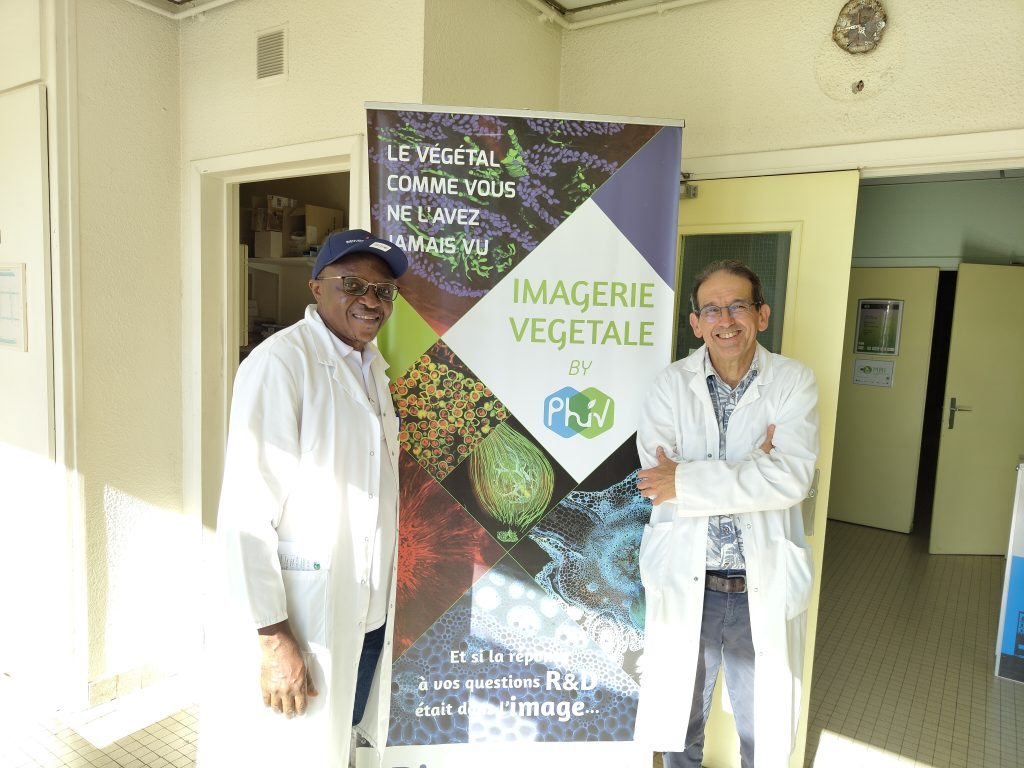
Imaging 4 All grantee Brice TONFACK with his host, Jean-Luc Verdeil at the MRI-PHiV imaging platform at CIRAD in Montpellier.
How did this collaboration enrich your scientific approaches?
[Brice] This collaboration strengthened my conviction that imaging is a central tool for understanding plant functioning: a good image is worth a thousand words! It led me to rethink the entire experimental workflow, from sample preparation to image analysis. Imaging, in interaction with physiology, biochemistry, genomics and agronomy, opens up a genuine scientific paradigm shift.
[Jean-Luc] Working with Brice on orphan tropical species profoundly enriched my approach to plant imaging, by placing it back at the heart of concrete biological, ecological and societal questions. Imaging should not be seen as an isolated discipline, but rather as a transversal language linking physiology, biochemistry, genomics, agronomy and ecology. This collaboration led us to rethink protocol design and the final purpose of the data produced, and it was also extremely enriching on a human level, establishing a relationship of trust that is essential for sustainable partnerships.
Brice, what did you gain from this experience on a professional level?
[Brice] Beyond access to technologies, this experience greatly strengthened my international visibility, as well as that of my institution. I was able to familiarise myself with high-level microscopy tools and generate a significant volume of data, which will be analysed in close collaboration with the MRI-PHiV team.
How does Global BioImaging promote balanced collaborations?
[Jean-Luc] Initiatives led by Global BioImaging go beyond a simple logic of access to equipment. They encourage the co-construction of projects, recognition of expertise and scientific priorities in Global South countries, and help reduce inequalities in access to advanced technologies. They benefit both visiting researchers and host platforms and create a framework of trust conducive to long-term collaborations. I also greatly appreciated working with Brice, whom I knew very little before this collaboration. This encounter was a deeply enriching human experience for me, personally, culturally and scientifically, and it greatly contributed to the quality, trust and depth of our collaboration.
How do you envisage the continuation of this collaboration?
[Brice] Yes, clearly. Data analysis will require close collaboration for at least one year, including publications, scientific communications and new research stays. In the longer term, we envisage student exchanges, training activities and joint projects, particularly in forest biotechnology and imaging applied to marine ecosystems.
[Jean-Luc] This collaboration marks the starting point of a structuring and sustainable scientific partnership. In the short term, joint data analysis will lead to several publications. In the longer term, we wish to develop exchanges of young researchers, imaging training activities and jointly respond to future calls for projects around plant imaging and tropical plant phenotyping.
Overview of the different imaging approaches used by Brice Tonfack to characterise Aframomum angustifolium seeds.
More news from Euro-BioImaging
November 18, 2026
From synchrotron research to clinical applications: Advancing lung imaging at Euro-BioImaging's Trieste Node
How can synchrotron-based imaging move from experimental research towards clinical applications? This was among the questions explored at the International Workshop on Pulmonary…
Euro-BioImaging at EMBL's Festival of Science & Curiosity
On Friday, 25 September 2026, Euro-BioImaging Bio-Hub team members joined the European Researchers’ Night celebrations at EMBL Heidelberg’s Festival of Science and Curiosity.