
October 16, 2026
RAISE Hub: One gateway to Europe’s AI in Science Community
A new online platform to connect researchers, infrastructures, and funders to accelerate AI scientific discovery across Europe Dublin, Ireland, 15 October…



Spatial transcriptomics is rapidly transforming the way researchers study complex biological systems. To explore the latest developments in this fast-moving field, Euro-BioImaging is organising a Special Edition Virtual Pub dedicated to Spatial Transcriptomics on Friday, June 12, from 13:00–15:00 CEST. The event will bring together experts from academia and industry to showcase cutting-edge spatial omics technologies, innovative workflows, and emerging applications.
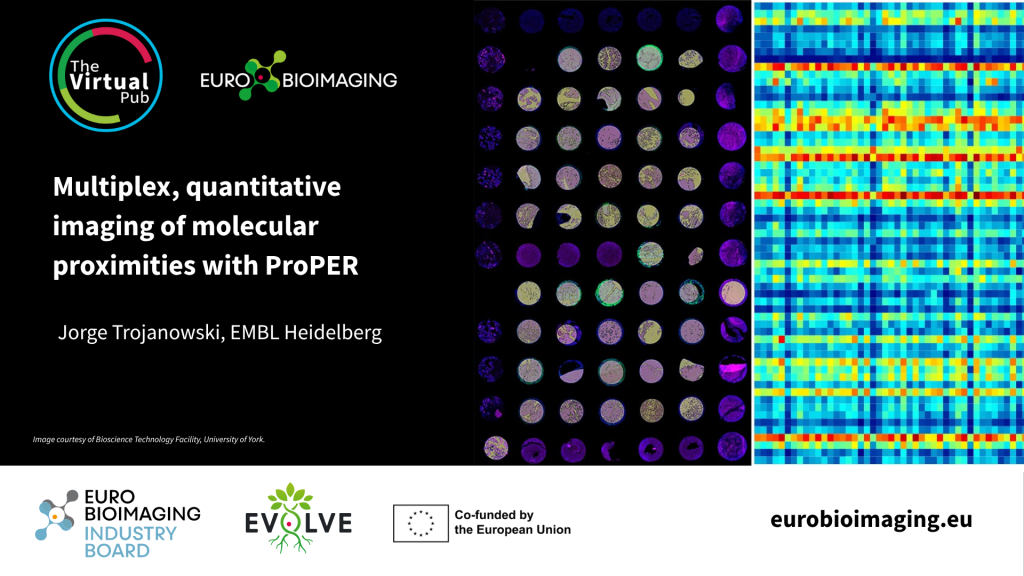
At this event, Jorge Trojanowski, EMBL Heidelberg, explores how ProPER - a new approach to detect molecular proximity without ligation - can be flexibly adapted to detect protein-protein or RNA-RNA interactions in situ and that it achieves efficient labeling of proximity sites even at high densities.
Like all Euro-BioImaging Virtual Pubs, this online event offers an open forum for the imaging community to exchange ideas, discover new technologies, and discuss practical applications with experts from across disciplines.
Multiplex, quantitative imaging of molecular proximities with ProPER
Jorge Trojanowski, EMBL Heidelberg
Proximity detection methods label subpopulations of molecules based on their spatial context and interaction partners and provide a layer of spatial information that goes beyond molecular abundance and location. However, existing methods typically have low detection efficiencies and do not offer multi-modal readouts which limits their use in quantitative or systems biology studies. To address this, the team developed a novel approach called proximity primer exchange reaction (“ProPER”). Compared with widely used proximity ligation assays, ProPER detects molecular proximity without ligation: when target-bound primer and hairpin probes are localized together, they initiate an isothermal polymerase reaction that extends the proximity barcode into a single-stranded DNA concatemer.
In this talk, Jorge demonstrates that ProPER can be flexibly adapted to detect protein-protein or RNA-RNA interactions in situ and that it achieves efficient labeling of proximity sites even at high densities.
To demonstrate this, the team employed ProPER to resolve the life cycle stage of individual RNA molecules in the same cell by multiplex proximity detection and fluorescent imaging and used the quantitative data to trace the causes of expression delay between inflammatory response genes.
Overall, ProPER offers a versatile scheme for multiplexed proximity detection and supports
quantitative single-cell and single-molecule level measurements. Utilisation of DNA barcodes
opens the possibility for incorporating proximity detection into other spatial omics workflows and supports further development of more advanced capabilities, such as multi-way interaction detection or proximity cascades.
October 16, 2026
A new online platform to connect researchers, infrastructures, and funders to accelerate AI scientific discovery across Europe Dublin, Ireland, 15 October…
October 16, 2026
At the Special Edition Virtual Pub, “Imaging Micro- and Nanoplastics,” Euro-BioImaging users, Node experts and Industry partners will explore how advanced microscopy, clinical…
October 16, 2026
At the Special Edition Virtual Pub, “Imaging Micro- and Nanoplastics,” Euro-BioImaging users, Node experts and Industry partners will explore how advanced microscopy, clinical…