Jonas Bagge is a PhD Fellow in the Department of Biology at the University of Copenhagen. His speciality is DNA repair, with a specific focus on how TopBP1 protein contributes to maintaining genome integrity during mitosis. With only one year left to finalize his doctoral research, Jonas planned to travel to Euro-BioImaging’s EMBL Node in Heidelberg, Germany, to use stimulated emission depletion (STED) super-resolution microscopy to observe the location of TopBP1 in human cells in specific mitotic stages. But travel restrictions due to the corona emergency changed those plans. As a result, Jonas became the first Euro-BioImaging user to access EMBL’s STED microscope remotely. In this article, Jonas Bagge and Dr. Marko Lampe, of the Advanced Light Microscopy Facility, EMBL, reflect on this new mode of working.
Copenhagen is home to many state-of-the-art imaging centers, but none of the neighboring laboratories offer the particular technology and expertise that Jonas needed. His experiment involved a specific approach using STED microscopy to study mitosis in human cells that was developed at EMBL. The expertise of the EMBL staff would be invaluable to his research, which is why he had applied for access to this facility via Euro-BioImaging.
Adapting to COVID-19 times
But one day before Jonas’s flight was scheduled to leave Copenhagen for Germany, in September 2020, Denmark was placed on the red list of risk countries by German health authorities. Jonas would be subject to 2 weeks’ mandatory quarantine upon his arrival in Germany. On top of that, his flight was canceled.
Meanwhile, Marko Lampe had received Jonas’ samples in Heidelberg via courier service. They were in great shape. Marko asked Jonas if he would be interested in carrying out his experiment remotely. Jonas quickly agreed.
“Given the situation, this was the best-case scenario for the experiment to be led. The machines had been reserved, and the samples were in good shape. We understood exactly what Jonas wanted to do,” explained Marko.
Working remotely
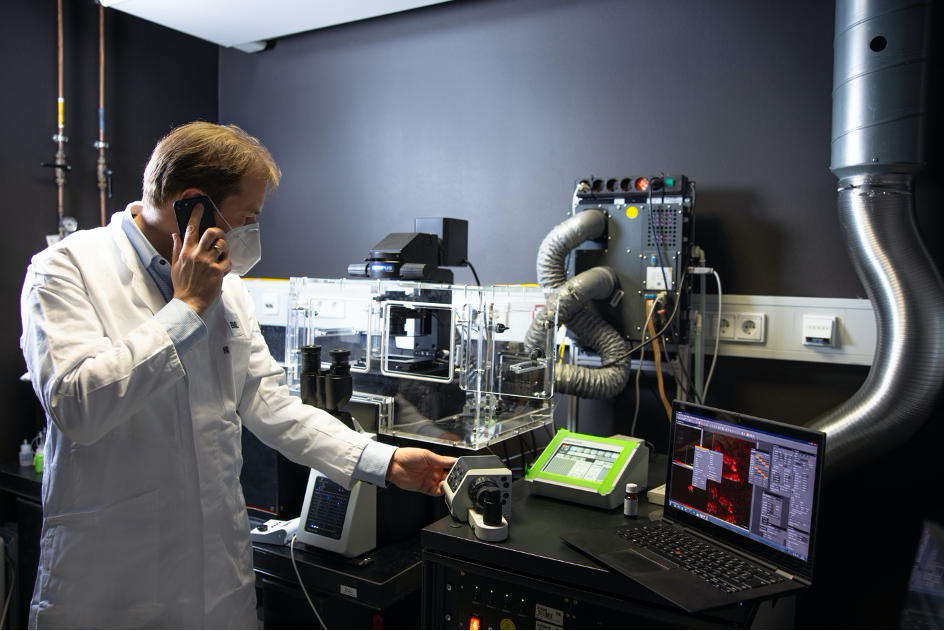
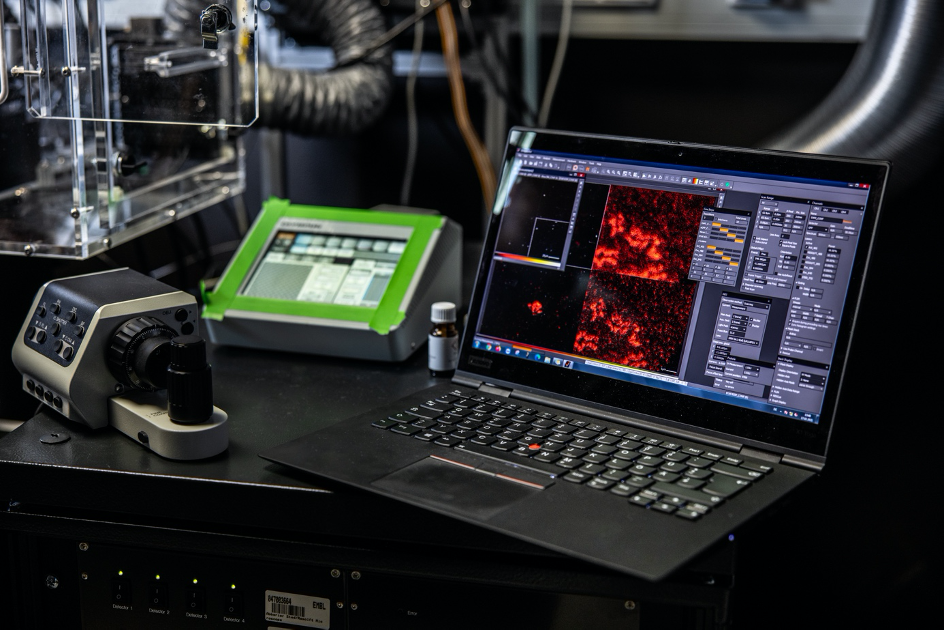
Over the following week, Marko and Jonas worked together to study the cell lines. First, Marko trained Jonas remotely on the operation of the microscope almost in the same manner, as he would have trained Jonas during an onsite visit. On the following days, Marko set up an-internet connected laptop in the microscope room with a permanent Zoom session open so that Jonas could access the machine. Each day, Marko set up the sample, but once the sample was in place, Jonas was independent. He used the machine to zoom in on areas of interest, and transferred the raw data to his university in real-time. If there was a problem, Jonas called Marko’s on his cell phone for help.
Marko Lampe, of the Advanced Light Microscopy Facility, EMBL, adjusts the STED microscope for remote user access. An-internet connected laptop in the microscope room with a permanent Zoom session allows remote users to visualize data. Photo copyright: EMBL/Kinga Lubowiecka
The importance of auto-focus
For Jonas, the hardest part of the virtual experience was anticipating for the time delay between sending a command to the microscope and the moment he was seeing the result on the screen and - as images were compressed twice, between the microscope and the video conference application- finding the optimal focus:
“If the focus was a little bit off initially, that would affect the quality of the image later. It was the delay that was the trickiest. I was constantly streaming raw data to verify the focus,” explains Jonas. After optimizing the auto-focus function of the microscope for Jonas’ samples, these issues were solved and the imaging got easier and faster for the remaining days.
The importance of densely-populated samples
From Marko’s perspective, this was the first remote experiment with someone outside of EMBL, and it was a clear success. One important factor was Jonas’ samples: there were many cells on the cover slip and Marko did not have to look laboriously for a particular region on the slide before Jonas could take over control. Marko emphasizes that not all kind of samples would have allowed remote access, but Jonas’ project perfectly matched the prerequisites.
While both agree that a remote visit does not replace an in-person visit, in this case, working remotely made it possible for Jonas to perform an experiment in a timely fashion during COVID-19 times. He was very happy with the results, which he and his team hope to publish in the near future. But he still hopes to visit EMBL during his PhD to perform other experiments and learn more about STED microscopy.
Want to visit EMBL remotely? Yes, you can!
And thanks to this successful virtual experiment, EMBL is pleased to offer this type of service to other users across Europe through Euro-BioImaging. If you are interested in conducting such an experiment, please reach out to the EMBL team, who will discuss the feasibility of your remote experiment with you and advise you on how to make it work.
A laptop makes it possible for users to remotely control the STED machine at Euro-BioImaging’s EMBL Node. Photo copyright: EMBL/Kinga Lubowiecka
About Euro-BioImaging’s EMBL Node
The Euro-BioImaging EMBL-Node offers a collection of state-of-the-art microscopy equipment and image processing tools. This Node supports in-house scientists and visitors in using microscopy methods for their research and regularly organizes international training courses to teach basic and advanced microscopy methods. The services provided include project planning, sample preparation, microscope selection and use, image processing and visualization. Through Euro-BioImaging, life scientists, regardless of their affiliation or area of expertise, can apply to access services from 25 Nodes, composed of internationally-renowned imaging facilities.
More news from Euro-BioImaging
April 9, 2026
Major EU funding for user access & AI development, staff training, data stewardship & many more exciting new services!
Euro-BioImaging ERIC is deeply grateful to announce that the European Union has entrusted our infrastructure with funding to shape the future of imaging and…
Euro-BioImaging is looking for an Operations Support Assistant at the Euro-BioImaging Statutory Seat in Turku, Finland, to support the day-to-day financial and administrative operations…