Join the Special Edition Virtual Pub, “Innovation in Imaging,” where we will discuss some of the issues that innovators should be aware of and hear use cases from our network about successful tech transfer and translation from the lab.
When: September 27, 2024, from 13:00-15:30 CEST
Where: Online
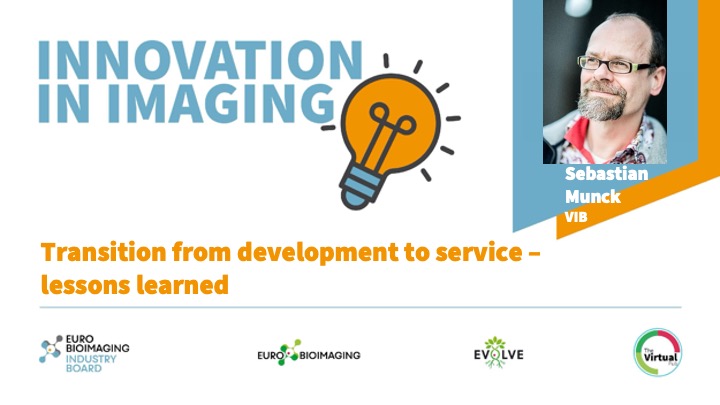
At this event, Sebastian Munck (VIB), will explain how establishing workflows and committing staff time to innovative/development activities can be beneficial for end-users, in a presentation entitled, “Transition from development to service – lessons learned.”
Transition from development to service – lessons learned
Sebastian Munck, VIB
Abstract
Core facilities are vital for providing services to departments and stakeholders, but without innovation, they risk stagnation and failure to advance science.
Core facilities are often based at discovery-based life science institutes, where development is a distinct activity and where a development project within a core facility is a temporary endeavour to produce a unique product, service, or result, turning a challenge into a solution. These projects vary in complexity, ranging from complete new imaging methods to protocol optimizations and technology adaptation.
Establishing workflows and committing staff time to innovative/development activities that benefit the majority of users is essential for creating scalable development projects for long-term service implementation. A road map with go-and-no-go decisions and milestones can make this process transparent.
Major EU funding for user access & AI development, staff training, data stewardship & many more exciting new services!
Euro-BioImaging ERIC is deeply grateful to announce that the European Union has entrusted our infrastructure with funding to shape the future of imaging and…
Euro-BioImaging is looking for an Operations Support Assistant at the Euro-BioImaging Statutory Seat in Turku, Finland, to support the day-to-day financial and administrative operations…