
October 8, 2026
Euro-BioImaging at ‘Data Stewardship goes Germany – from going to growing’
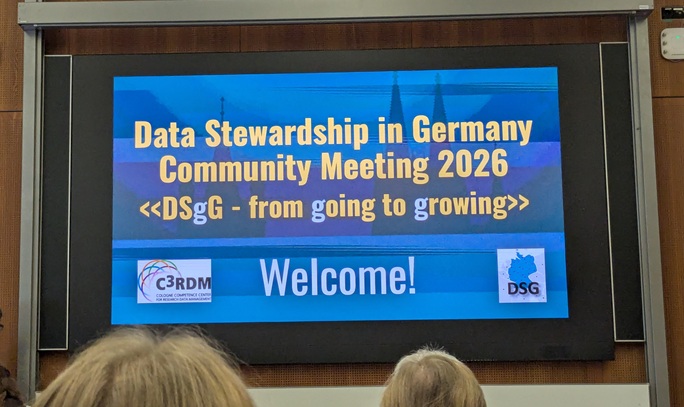
This September, Euro-BioImaging was part of the Data Stewardship goes Germany (DSgG) Community Meeting in Cologne. Under the theme “from going to…


Euro-BioImaging Bio-Hub team, hosted by EMBL in Heidelberg, is hiring a Data Architect/Knowledge Engineer - Euro-BioImaging (AI4Access) to support technical developments in the AI4Access project.
The Euro-BioImaging Access Portal is the infrastructure interface that enables users to browse, request and access imaging and image data technologies from an extensive and rich service portfolio. It is also the platform through which Euro-BioImaging and the service providing facilities manage the incoming access requests and user interactions. The AI4Access project will develop a “Research Navigator” (an LLM application) integrated into the Euro-BioImaging Access Portal to guide researchers to the right services, workflows and resources across the infrastructure. A key foundation is a structured, maintained ontology-aligned knowledge base that can be queried reliably by the Navigator.
We are looking for a technically strong colleague who will design, set up and maintain the database and data ingestion pipeline underlying the AI4Access ontology-driven knowledge base, work with the Euro-BioImaging Bio-Hub team and community on the development of relevant ontologies and knowledge graphs, and develop robust technical interfaces between the knowledge base and the Research Navigator together with the Euro-BioImaging Seat team and with the Euro-BioImaging Nodes’ own information and management systems.
Contract length: 3 years
October 8, 2026
This September, Euro-BioImaging was part of the Data Stewardship goes Germany (DSgG) Community Meeting in Cologne. Under the theme “from going to…

October 7, 2026
On 28–29 September 2026, the growing French volume electron microscopy (vEM) community came together in Bordeaux for the first France VolumeEM Scientific Days.

October 7, 2026
Euro-BioImaging joined partners from across Europe on 29. & 30. September 2026 at the official kick-off meeting for STARDAST, a new Horizon Europe…