
October 21, 2026
ESG4Stars project launched
On October 5-6, the ESG4Stars project was launched. ESG4stars aims to reduce the environmental impact of research infrastructures. The kick-off meeting and…



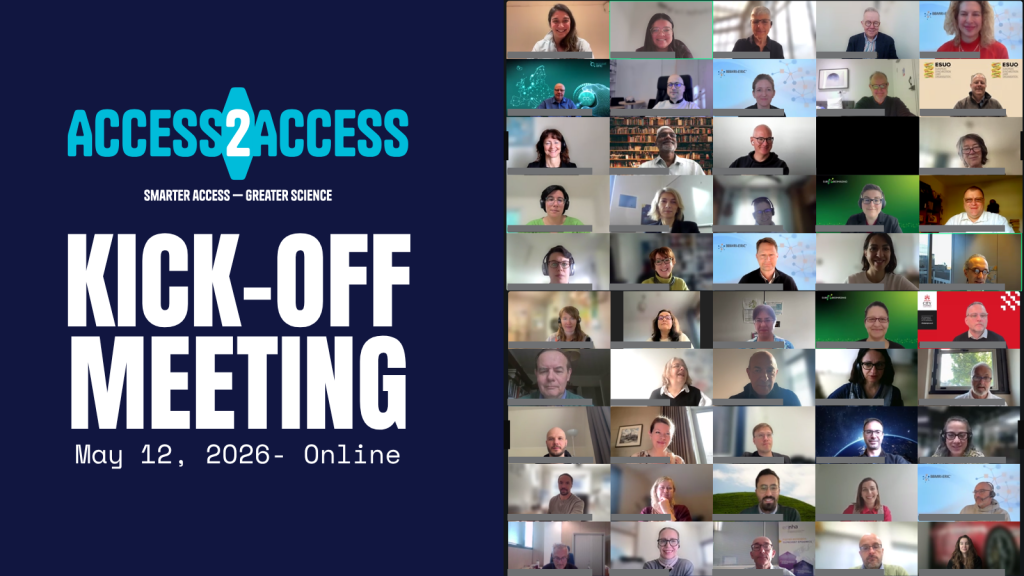
Following the official start of the project on 1 May 2026, the ACCESS2ACCESS consortium convened for its kick-off meeting on 12 May, bringing together a broad group of research infrastructure stakeholders, scientific communities, users, and policy experts from across Europe. The project will work closely with the community to co-design future models for transnational access (TNA) to research infrastructures and develop recommendations that will help shape future European frameworks.
Building on decades of practical experience with transnational access programmes, ACCESS2ACCESS aims to ensure that the future of transnational access reflects the needs of Europe’s highly diverse research infrastructure landscape, and first and foremost, the researchers and developers from academia and industry alike. The project will engage communities across the full breadth of science and technology. This includes life sciences, biomedical and health research, social sciences and humanities, environmental and Earth sciences, photon and neutron sciences, physics, chemistry, materials science, engineering, energy research, digital infrastructures, and high-performance computing. The project will also involve a wide range of user communities and research infrastructure models, including both distributed and single-site infrastructures.
A central objective of the project is to gather broad community input and identify best practices in order to propose inclusive and widely supported models for future transnational access (TNA) implementation. Given the strategic importance of TNA for European research and innovation, the project’s recommendations are expected to have a significant long-term impact on how access to research infrastructures is organised in the coming decade, helping to inform sustainable and future-oriented access models for the next generation of European research programmes. In addition, the project will produce a blueprint for an AI-assisted, problem-driven framework that will help users identify the most appropriate facilities, services, and expertise for their scientific and innovation challenges.
The project is coordinated by Euro-BioImaging ERIC, the European gateway to biological and biomedical imaging. For Euro-BioImaging, coordinating ACCESS2ACCESS represents both an important milestone and a significant responsibility. We are grateful for the trust placed in us by the European research infrastructure community and the European Commission to lead this strategic initiative. Throughout the project, our priority will be to work closely with stakeholders, including open consultations, across scientific domains and infrastructure models to ensure that the project outcomes reflect the realities and needs of Europe’s diverse research infrastructure landscape.
The consortium includes 17 partners in the core executive team, and a large representation of associated partners across scientific domains: Euro-BioImaging ERIC, European Synchrotron Radiation Facility (ESRF), European X-ray Free-Electron Laser Facility GmbH (EuXFEL), Helmholtz-Zentrum Dresden-Rossendorf (HZDR), AnaEE ERIC, ACTRIS ERIC, BBMRI-ERIC, Instruct-ERIC, INRAE (IBISBA), ECCSEL ERIC, National Institute of Oceanography and Applied Geophysics (OGS), CLARIN ERIC, Partnership for Advanced Computing in Europe (PRACE), CERIC-ERIC, European Science Foundation (ESF), Deutsches Elektronen-Synchrotron (DESY), and INESC TEC. The partners span all major scientific domains and combine substantial expertise in research infrastructure operations, user access, digital technologies, and science policy.
The consortium brings together strong scientific, technical, and policy expertise across research domains, creating a solid foundation for developing evidence-based and future-oriented approaches to transnational access in Europe. ACCESS2ACCESS also applies the concept of Supporting Partners to strengthen stakeholder engagement throughout the project implementation.
Associated partners include CESSDA ERIC, EATRIS ERIC, ECRIN, ERINHA, INFRAFRONTIER ERIC, JIV-ERIC, EBRAINS, ELI ERIC, EMBRC-ERIC, and ESS ERIC. Supporting partners from user communities, RTOs, and start-ups include ESUO, TILLER ALPHA GmbH, EuroTech Universities Alliance, Danish Technological Institute, and OPTICON Alliance. Additional supporting partners from research organisations and institutions include Max Planck Society, EGI Foundation, INFN, Helmholtz Association, Consiglio Nazionale delle Ricerche, Alfred Wegener Institute, CEA, and Joint Research Consortium.
Taken together, ACCESS2ACCESS addresses one of the most important strategic questions facing European science and innovation: how to ensure that world-class research infrastructures remain discoverable, accessible, and sustainably available to the brightest ideas, regardless of user background, discipline, sector, or country.
October 21, 2026
On October 5-6, the ESG4Stars project was launched. ESG4stars aims to reduce the environmental impact of research infrastructures. The kick-off meeting and…

October 16, 2026
A new online platform to connect researchers, infrastructures, and funders to accelerate AI scientific discovery across Europe Dublin, Ireland, 15 October…
October 16, 2026
At the Special Edition Virtual Pub, “Imaging Micro- and Nanoplastics,” Euro-BioImaging users, Node experts and Industry partners will explore how advanced microscopy, clinical…