
October 21, 2026
ESG4Stars project launched
On October 5-6, the ESG4Stars project was launched. ESG4stars aims to reduce the environmental impact of research infrastructures. The kick-off meeting and…



Euro-BioImaging, represented by Johanna Bischof, participated in the 5th International Spatial Biology Congress, held on May 27–28, 2026, in Rotterdam, the Netherlands. The meeting brought together researchers, technology developers, pharmaceutical industry representatives, core facilities, and bioinformaticians working across the rapidly evolving field of spatial biology and spatial omics.
The congress highlighted both the remarkable pace of technological innovation in the field and the growing importance of spatial approaches for understanding complex biological systems and diverse disease mechanisms. Across two days of presentations and discussions, participants explored applications ranging from oncology and neuroscience to cardiovascular disease, immunology, and drug development.
Spatial biology is an umbrella term for a wide range of methods that combine advanced imaging approaches with transcriptomics, proteomics, metabolomics, and lipidomics, depending on the specific implementation. The congress showcased how increasingly integrated workflows are enabling researchers to move from two-dimensional imaging toward highly multiplexed and even three-dimensional analyses of tissues and cellular interactions on the molecular and functional level.
A recurring theme throughout the meeting was the strong convergence between imaging technologies, sequencing-based and highly multiplexed approaches, AI-driven data analysis, and multimodal data integration. Sessions covered developments in spatial transcriptomics, imaging mass spectrometry, multiplexing, computational analysis pipelines, and machine learning approaches for large-scale spatial datasets.
The conference also highlighted the importance of FAIR and reproducible data analysis workflows, standardisation, and scalable computational infrastructure — areas that are increasingly important as spatial biology datasets continue to grow in complexity and size. Presentations on data integration, benchmarking, and analysis platforms reflected the growing need for coordinated infrastructure support in the field.
One notable aspect of the congress was the strong participation from the pharmaceutical and biotechnology sectors, with presentations from researchers and scientists from Sanofi, Bayer Pharma AG, GSK, Genmab, Medicines Discovery Catapult, and multiple technology providers.
“Many Euro-BioImaging Nodes already support researchers working with spatial omics approaches, and we see strong interest from both the scientific community and core facilities in building further expertise, collaborations, and shared best practices in this area."
-- Johanna Bischof, Head of Bio-Hub Operations
The congress exhibition and technology showcases demonstrated the rapidly expanding ecosystem of spatial biology instrumentation, reagents, imaging platforms, and data analysis tools. Discussions throughout the meeting reflected both the excitement surrounding the field and the practical challenges associated with integrating increasingly complex multimodal workflows into research and translational applications.
Roundtable discussions also focused on training needs, workforce development, and the importance of bridging expertise across imaging, tissue preparation, sequencing technologies, bioinformatics, and image analysis. These discussions strongly resonated with the core facility and research infrastructure communities represented at the meeting.
Euro-BioImaging was represented at the congress by Johanna Bischof, Head of Bio-Hub Operations, who presented an overview of Euro-BioImaging services and opportunities for researchers and facilities working in spatial biology. The presentation highlighted Euro-BioImaging’s open-access model for imaging technologies, expertise, and data services, the diverse spatial biology approaches available at the Euro-BioImaging Nodes, as well as opportunities for collaboration, technology development, and skill building across the infrastructure.
The meeting also featured participation from Euro-BioImaging Nodes, including Israel BioImaging and Advanced NL-BioImaging, reflecting the strong expertise already present within the Euro-BioImaging community in spatial biology and related technologies.
For Euro-BioImaging, the congress represented an important opportunity to engage with a fast-growing and highly interdisciplinary community that naturally connects imaging technologies, molecular profiling, and advanced data analysis. Many Euro-BioImaging Nodes already provide services relevant to spatial biology, while the infrastructure’s growing portfolio of image data and analysis services offers important support for data-intensive spatial omics workflows.
“Spatial biology is an exceptionally dynamic and interdisciplinary field that is bringing together imaging, molecular profiling, bioinformatics, and AI-driven analysis in entirely new ways,” said Johanna Bischof, Head of Bio-Hub Operations at Euro-BioImaging. “Many Euro-BioImaging Nodes already support researchers working with spatial omics approaches, and we see strong interest from both the scientific community and core facilities in building further expertise, collaborations, and shared best practices in this area. Meetings such as the International Spatial Biology Congress are extremely valuable for connecting these communities and helping shape how research infrastructures can best support this rapidly evolving field.”
The congress also aligned closely with Euro-BioImaging’s broader engagement with spatial omics throughout 2026, including dedicated Virtual Pub presentations, Virtual Pub special editions, mentoring programmes, and training activities focused on emerging spatial biology technologies and workflows.
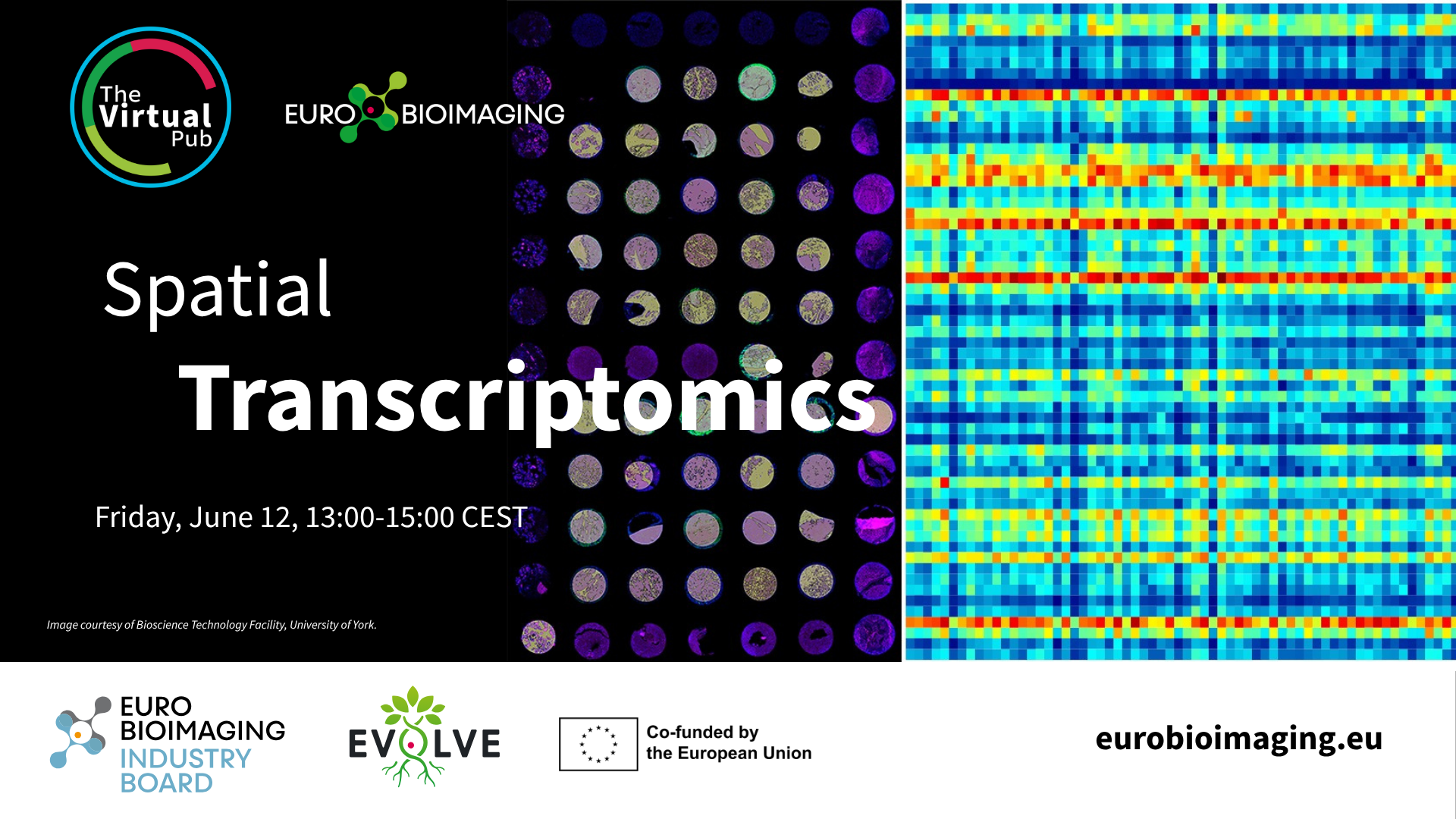
Special Edition Virtual Pub on Spatial Transriptomics
On Friday, June 12, 2026, Euro-BioImaging hosted a Special Edition Virtual Pub on Spatial Transcriptomics with multiple speakers from academia and industry.
Throughout the congress, there was a strong sense that spatial biology is rapidly evolving from a collection of emerging technologies into a broader scientific and technological community with increasing translational relevance.
As methods, datasets, and workflows continue to develop, research infrastructures and core facilities will play an increasingly important role in supporting access to technologies, expertise, training, and data analysis, while also supporting best practices, quality control, and data standards. The International Spatial Biology Congress highlighted the value of collaborative and interdisciplinary approaches in helping researchers navigate this rapidly changing landscape and accelerating the adoption of spatial biology technologies across research domains.
October 21, 2026
On October 5-6, the ESG4Stars project was launched. ESG4stars aims to reduce the environmental impact of research infrastructures. The kick-off meeting and…

October 16, 2026
A new online platform to connect researchers, infrastructures, and funders to accelerate AI scientific discovery across Europe Dublin, Ireland, 15 October…
October 16, 2026
At the Special Edition Virtual Pub, “Imaging Micro- and Nanoplastics,” Euro-BioImaging users, Node experts and Industry partners will explore how advanced microscopy, clinical…