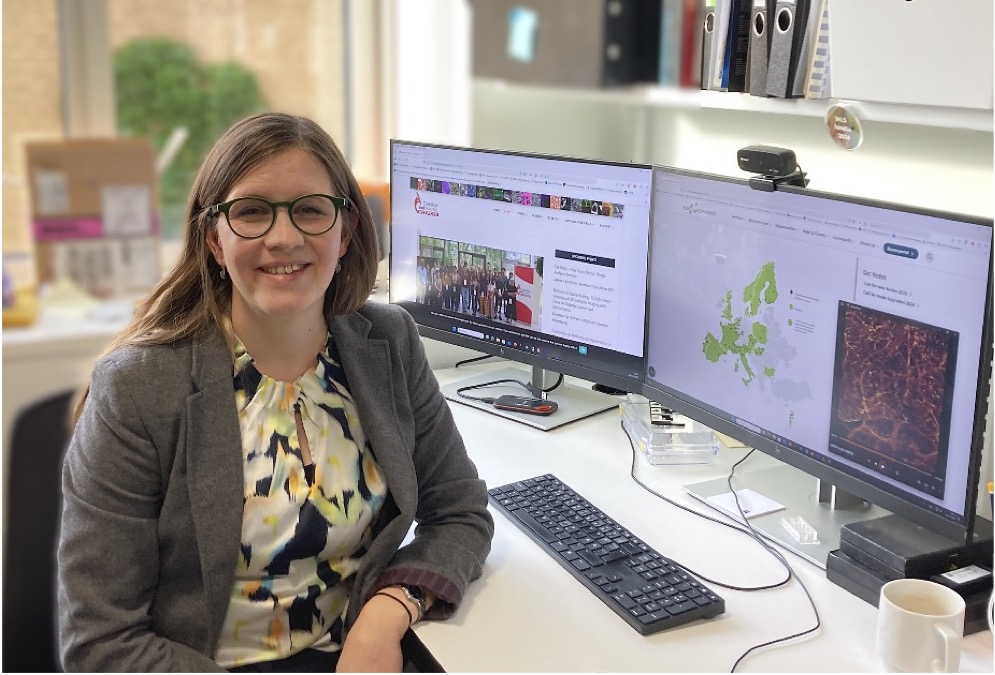
In this edition of the Meet the Nodes interview series, we introduce Pavla Francová, Senior Imaging Scientist and Project Coordinator at CAPI (Center for Advanced Preclinical Imaging) Node in Czech Republic. Pavla has been part of CAPI almost since its foundation and has played a central role in shaping the facility’s development, evolving from a newly established infrastructure into a growing, highly specialised preclinical imaging center.
Pavla's role at CAPI
Pavla joined CAPI in March 2016, shortly after the facility officially opened. Trained as a biomedical engineer, she started her career in preclinical MRI, later moving into a coordination role that bridges science, operations, and administration.
Today, Pavla works closely with CAPI’s leadership as a project coordinator, supporting everything from project preparation and facility operations to long-term strategic planning. Having been involved since the earliest days, she has also become a key source of institutional knowledge.
Because I was here from the very beginning, I’m often the one people come to when they need to remember how something was done years ago.
A career shaped by transitions
Before joining CAPI, Pavla’s career path moved between preclinical and clinical MRI environments. While clinical imaging offered valuable experience, she soon realised that her background as a biomedical engineer limited long-term opportunities in clinical departments.
She then spent time at the National Technical Library, where she contributed to building services supporting researchers and academic users. This experience strengthened her understanding of institutional support structures, which later proved essential in her role at CAPI. When she learned about the newly established preclinical imaging facility, she joined within a matter of weeks.
From single-modality research to multimodal imaging
One of the aspects Pavla values most about her work at CAPI is the transition from a single-modality focus to multimodal imaging. What started with just a few imaging techniques has expanded into a portfolio of around ten modalities, covering a wide range of preclinical applications.
Each modality has its strengths and limitations. Combining them allows us to cover blind spots and extract much richer information.
User support at the core
As a core facility, CAPI provides end-to-end support for its users. Pavla explains that this goes far beyond operating imaging systems.
From early project planning and ethical approvals to data acquisition, reporting, and preparation for data sharing, the team supports researchers at every stage. They also actively share information on funding opportunities and training initiatives whenever relevant.
A key advantage is the availability of an in-house breeding facility (Center for Experimental Biomodels). In addition, dedicated mouse and rat housing is available directly within the CAPI laboratories. This setup reduces logistical complexity and allows both researchers and facility staff to focus more on experimental design and data quality.
Pavla Francová in front of the brand new MARS Microlab scanner, a photon-counting CT system for clinical research, at CAPI Node.
Learn more about the brand new MARS Microlab scanner, a photon-counting CT system for clinical research, at CAPI!
Facing the challenges of data management
Managing preclinical imaging data remains one of the most complex challenges. The diversity of datasets - spanning different imaging modalities, biological samples, chemistry, and longitudinal studies - means that a fully suitable unified repository is currently not available.
The closest existing solution is the PIDAR metadata repository, which has recently introduced limited data upload capabilities, primarily for datasets associated with peer-reviewed publications.
In parallel, CAPI has established its own FAIR data team to define internal policies, improve workflows, and develop automation strategies, which are essential given the scale and complexity of the data.
Favourite technologies
Although Pavla’s scientific background is rooted in MRI, she works across multiple modalities and continues to expand her expertise.
In addition to MRI, she highlights CT and nuclear imaging (PET/SPECT) as key technologies, particularly for combining anatomical and functional information. More recently, she has also developed a strong interest in ultrasound combined with photoacoustic imaging (US + PAI).
Looking ahead: growth, people, and innovation
CAPI continues to expand with future plans including relocation to a new campus that could significantly increase space and capacity. This would allow the facility to grow its instrumentation, improve workflows, and accommodate an increasing user demand.
Key priorities for the coming years include:
Expanding neuroimaging capabilities
Strengthening multimodal and correlative imaging approaches
Integrating AI tools into image analysis and evaluation
Improving registration and longitudinal imaging workflows
Pavla emphasises that the main challenge is not simply staffing numbers, but the need for highly motivated and adaptable people capable of working across a wide range of disciplines — from biology and biochemistry to imaging physics, data analysis, and communication.
This field requires people who are willing to learn continuously and work across disciplines. It’s demanding, but also very rewarding.
Advice for early-career scientists and technicians
When asked what advice she would give to young professionals considering a career in imaging facilities, Pavla reflects on her own non-linear path:
Do what you love and focus on what truly interests you. Everything else will grow from that, and you never know where the path will lead.
She remains optimistic about the future of imaging infrastructures and the opportunities they offer for those willing to combine technical expertise, curiosity, and adaptability.
More news from Euro-BioImaging
October 27, 2026
Meet Nina: Connecting Biology, Physics and People through Bioimaging
As part of our series highlighting the scientists behind the Euro-BioImaging Nodes, our Scientific Ambassador, Prasanna Padmanaban met with Dr. Nina Glöckner Burmeister,…
The EOSC Symposium 2026 took place from October 14-16, in Florence, Italy. More than 500 participants from 35 countries gathered there, including Euro-BioImaging’s…