
September 14, 2026
Danish BioImaging expands!
We are delighted to welcome the Laboratory, Automation, Screening, and Microscopy facility at the Biotech Research & Innovation Centre (BRIC), University of Copenhagen, to…
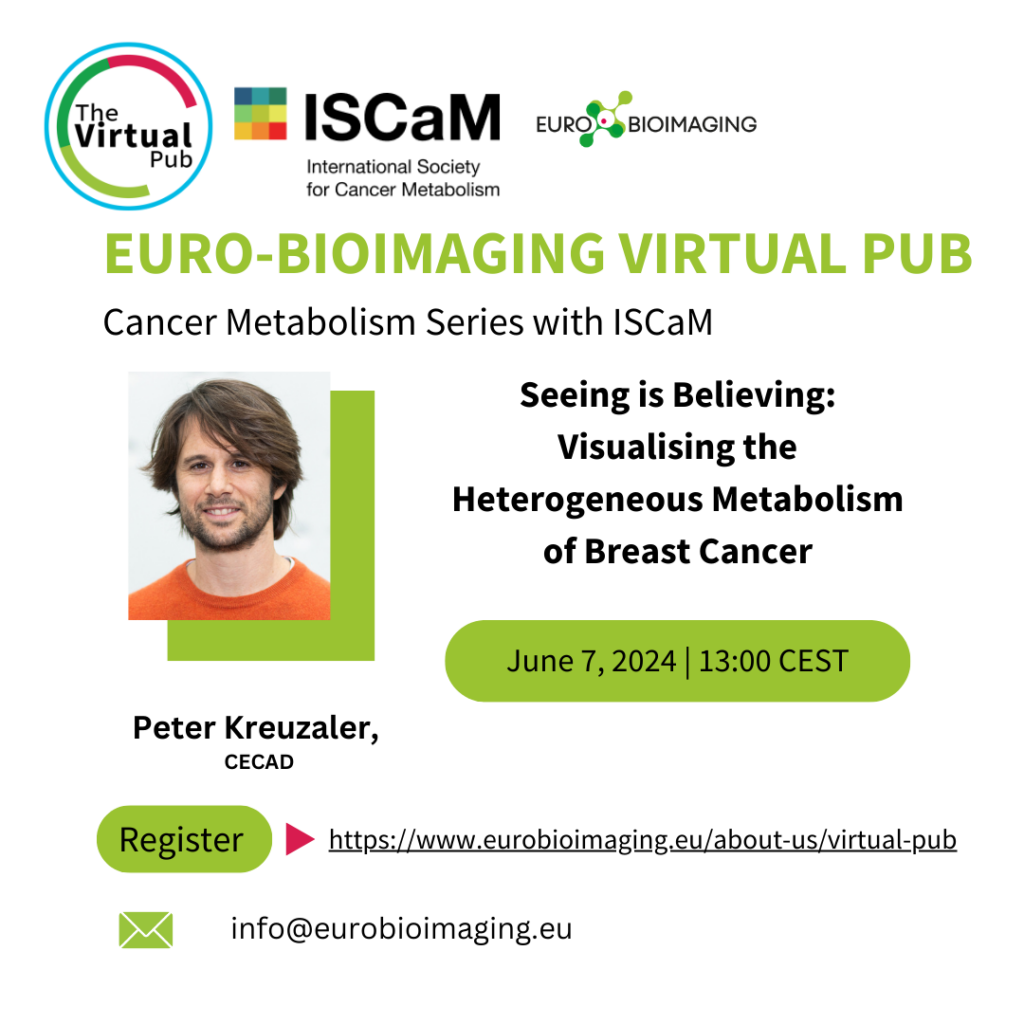
On June 7, 2024, Euro-BioImaging hosts the Cancer Metabolism Series in collaboration with the International Society of Cancer Metabolism (ISCaM). This series of lectures takes place once a month during the Virtual Pub, bringing together speakers from the cancer metabolism field with imaging experts from the Euro-BioImaging network, for exchange with enthusiasts from the biological & biomedical imaging fields in the Virtual Pub audience. Our speaker on June 7 is Peter Kreuzaler, with a talk entitled "Seeing is Believing: Visualising the Heterogeneous Metabolism of Breast Cancer."
Registration is free and open to all. Click to register to attend the Virtual Pub every Friday.
Tumours undergo constant Darwinian evolution and clonal diversification, the net result of which tends to be increased aggressiveness and invasiveness. These incipient clones can differ significantly in their metabolic needs, however the precise analysis thereof poses significant challenges due to the ephemeral nature of many metabolites and the fact that analysis is usually carried out in bulk. Using a suit of Mass Spectrometric Imaging techniques, we identify pantothenic acid (Vitamin B5) as a key metabolite required for tumour progression mediated by the oncogene Myc. Areas of high Myc expression showed increased pantothenic acid uptake, resulting in higher levels of CoA and increased Krebs cycle activity. Importantly, its deprivation reversed many of the metabolic changes mediated by Myc, and reduced tumour growth in both murine tumours as well as patient derived xenografts.
Peter Kreuzaler received his degree in biochemistry from the Free University in Berlin. He was then awarded a scholarship to study for a PhD in the laboratory of Prof. Christine Watson at the University of Cambridge, where he discovered a novel type of physiological cell death. On the back of this work, Peter was elected a Junior Research Fellow at Trinity College Cambridge, and spend his time as such studying clonal heterogeneity in breast cancer in the laboratory of Prof. Gerard Evan. This project sparked his interested in spatial omics and he thus joined Dr Mariia Yuneva’s team at the Francis Crick Institute as part of the CRUK Grand Challenge Rosetta team. Here he established several techniques in the field of Mass Spec imaging, and found a link between cancer progression and the need for Vitamin B5 uptake. Since August 2023 Peter runs his own research group as an independent group leader at CECAD in Cologne studying the organisation of (patho)physiological tissue niches.

September 14, 2026
We are delighted to welcome the Laboratory, Automation, Screening, and Microscopy facility at the Biotech Research & Innovation Centre (BRIC), University of Copenhagen, to…
September 11, 2026
A new paper published in the Journal of Microscopy brings together several years of community work around FAIR bioimage analysis in Galaxy.
September 10, 2026
Developing new experimental models for cancer research requires not only innovative technologies, but also the ability to see what is happening inside complex…